Pages

Blogger templates

Blogroll

Labels

Featured 1

Curabitur et lectus vitae purus tincidunt laoreet sit amet ac ipsum. Proin tincidunt mattis nisi a scelerisque. Aliquam placerat dapibus eros non ullamcorper. Integer interdum ullamcorper venenatis. Pellentesque habitant morbi tristique senectus et netus et malesuada fames ac turpis egestas.

Featured 2

Curabitur et lectus vitae purus tincidunt laoreet sit amet ac ipsum. Proin tincidunt mattis nisi a scelerisque. Aliquam placerat dapibus eros non ullamcorper. Integer interdum ullamcorper venenatis. Pellentesque habitant morbi tristique senectus et netus et malesuada fames ac turpis egestas.

Featured 3

Curabitur et lectus vitae purus tincidunt laoreet sit amet ac ipsum. Proin tincidunt mattis nisi a scelerisque. Aliquam placerat dapibus eros non ullamcorper. Integer interdum ullamcorper venenatis. Pellentesque habitant morbi tristique senectus et netus et malesuada fames ac turpis egestas.

Featured 4

Curabitur et lectus vitae purus tincidunt laoreet sit amet ac ipsum. Proin tincidunt mattis nisi a scelerisque. Aliquam placerat dapibus eros non ullamcorper. Integer interdum ullamcorper venenatis. Pellentesque habitant morbi tristique senectus et netus et malesuada fames ac turpis egestas.

Featured 5

Curabitur et lectus vitae purus tincidunt laoreet sit amet ac ipsum. Proin tincidunt mattis nisi a scelerisque. Aliquam placerat dapibus eros non ullamcorper. Integer interdum ullamcorper venenatis. Pellentesque habitant morbi tristique senectus et netus et malesuada fames ac turpis egestas.

Showing posts with label 50's. Show all posts

Friday, June 28, 2013

Only now does it occur to me... JUBAL

Only now does it occur to me...  that my lifelong dream to see Charles Bronson throw a table at Ernest Borgnine would one day be realized!


Sheer visual poetry!  And from the freeze-framing, it looks like Bronson is in fact heaving that table across the room, while Borgnine has been replaced by a stunt double.

The movie's pretty good, too– a loose (very loose) retelling of OTHELLO (with Borgnine as Marty– I mean Othello, Rod Steiger as Iago, Valerie French as Desdemona, and Glenn Ford as Cassio),
JUBAL is a beautiful Eastmancolor Western that's tense, well-acted, and bursting with Douglas Sirk-ian melodrama.  It's not quite as good as my other Delmer Daves favorites (DARK PASSAGE and 3:10 TO YUMA), but it's well worth your time (even though Bronson's only in a supporting role).  It's also clear that Sergio Leone was a Delmer Daves fan, and it's funny how many of the film's tableaux are comprised entirely of actors who would go on to work with the Spaghetti Master:

Rod Steiger (DUCK, YOU SUCKER) and henchman Jack Elam (ONCE UPON A TIME IN THE WEST.)

Charles Bronson (even wearing practically the same hat as in ONCE UPON A TIME IN THE WEST) faces off with Steiger.

Monday, May 27, 2013

Book Review: THREE BAD MEN: JOHN FORD, JOHN WAYNE, WARD BOND (2013, Scott Allen Nollen)


I'm a longtime fan of John Ford (who isn't, really?), the patron-saint of Monument Valley, born-again Irishman, and director of some of the best-constructed, most thoughtful films to come out of Hollywood, from THE INFORMER to THE MAN WHO SHOT LIBERTY VALANCE to THE QUIET MAN to THE GRAPES OF WRATH.
John Wayne is, so to speak, John Wayne, though his work frequently transcends the "movie star" mold with a dancer's grace and a touch of madness like in Ford's THE SEARCHERS, Hawks' RED RIVER, and Siegel's THE SHOOTIST.
Then, there's Ward Bond: a character actor extraordinaire who played brutes and cowpokes and priests and boxers across more than two hundred films.  Though his supporting work with Ford and Wayne is why he's included in this trio, my soft spot for him will always be his one and only shot at top-billing in 1942's HITLER: DEAD OR ALIVE, a film that clearly inspired INGLOURIOUS BASTERDS and contains the fabulous spectacle of Ward slapping the shit out of Hitler himself ...before proceeding to force-shave off his mustache! 

Anyway, I just finished reading Scott Allen Nollen's in-depth examination of the lives and work of these three cinematic giants, and I highly recommend it as a fascinating study for burgeoning old-Hollywood aficionados and serious fans of cinema alike.  Chronologically tracing the intertwining lives of these three "good-bad men" who were not unlike the characters in their films (Ford directed Bond and Wayne in nearly thirty pictures each), Nollen is at once objective and affectionate in his analysis, and there's a wealth of source material including documents, letters, telegrams, and plenty of rare photographs.  There are riveting anecdotes (I may now actually be inspired to read Harry Carey, Jr.'s autobiography), some great yarn-spinning (including tales of Ward Bond's brutish, high-flying, indecent-exposing, Wile E. Coyote-style antics and his ruining of a key scene in THE SEARCHERS when he unplugged the camera to plug in his electric razor!), and the work definitely touches on their peccadillos and absurdities, though never salaciously.

It's deftly written and never dry; while many books of this kind become bogged down by academic posturing, Nollen remains true to the spirit of his subjects and opts for a two-fisted, no bullshit approach.  I really appreciate how deeply he throws himself into the work, freely admitting "a meaningful (though a bit one-sided) conversation with a tombstone or two."  He's as a film writer should be– intense, obsessive, and highly-focused; reverent without succumbing to hollow adulation.

The main drive of the work is the examination of the complex personal and working relationship between the three (though large swaths of the book are dedicated to advancing the underrated Ward Bond to his rightful place in the pantheon).  None of these men could really be pinned down or branded with a particular stereotype– each had a volatile mix of id and ego (often sprinkled heavily with alcohol) that fused together to create a kind of perfect storm of filmic art. 
The complex psychology of Ford's relationships with the two men is indeed worthy of an entire volume– you see a strange kind of ownership emerge, resulting from Ford's "discovering" of the two actors.  This ownership was generally expressed in verbal (and often physical) sadism as Ford became master of his "whipping boys," something which may have even tied into his potential bisexuality:
"Ford loved John Wayne and Ward Bond, but his true sexual orientation wasn't something he would have discussed with them, or anyone else.  When it came to his own life and psyche, Pappy [Ford] avoided the truth, exaggerated, lied, or just didn't 'have any goddamn idea.'  The positive emotions he felt for his two favorite actors and whipping boys may have been the underlying cause of his negative, sadistic treatment of them (and himself); but even a lifetime of psychoanalysis may not have 'proved' anything."
Vindictive and controlling, Ford "froze out" Wayne for eight years when he appeared in a rival director's Western (Raoul Walsh's THE BIG TRAIL) and later, when Bond made serious forays into television (WAGON TRAIN) and Wayne tried to direct a picture of his own (THE ALAMO), Ford would sometimes install himself as a presence on set and attempt to undermine/co-opt the work therein.  These behaviors even extended beyond the trio– he punched out Henry Fonda (!) on MISTER ROBERTS and made cruel, deliberate use of alcohol to wring earth-shattering, hungover performances out of the likes of Victor McLaglen in THE INFORMER and Woody Strode in SERGEANT RUTLEDGE.

Though he reveals these men "warts and all," Nollen also paints a portrait of devoted friends and masterful artists whose lives and creative outlets meshed almost completely.  (For instance, despite the abuse, Ford chose Bond to play his own alter-ego in the deeply personal THE WINGS OF EAGLES.) 

Nollen takes on the accusations of racism in Ford's films, and reveals his struggle to show all sides despite the constraints of the system– especially evident in films like THE SEARCHERS, SERGEANT RUTLEDGE, and CHEYENNE AUTUMN.  He tackles the strange political spectrum of the men, too, with John Ford's patriotic progressivism, Wayne's conservatism, and Ward Bond's ultraconservatism (and yet it was Ford who took his camera overseas into the crucible of World War II while Wayne and Bond remained in Hollywood).  He doesn't shy away from Ward Bond's shameful behavior in the McCarthy era as a supporter of the blacklist:
"The social climbing Bond's ultimate political affront to Ford involved an invitation to a party he was throwing for Senator Joseph McCarthy.  His great mentor [Ford] simply answered, 'You can take your party and shove it.  I wouldn't meet that guy in a whorehouse.  He's a disgrace and a danger to our country.'"
Bond's involvement with the blacklist feels like a moral counterpoint to Ford's extensive work with the U.S. armed forces in World War II and beyond, and much attention here is paid to his military career (I learned that in North Africa a Nazi actually surrendered himself to John Ford!) 

Along the way, Nollen delves into a vast spectrum of material including Ford's relationship with his older brother Francis (mentor, actor, and silent film director), Ford's gleeful propensity for Chaucer/Shakespearean-style low comedy and his hilariously bizarre obsession with highlighting Ward Bond's "horse's ass" in shot compositions ("Although FORT APACHE is a serious examination of the mythology of the American West, it humorously can be branded Ford's 'ass-travaganza'").  Of particular interest to me were Ford's work with Victor McLaglen (whose performance in THE INFORMER is one of the greatest in filmdom), his direction of genius child actor and later genre-movie legend Roddy McDowall in HOW GREEN WAS MY VALLEY,  Bond's artistic process as unofficial show-runner on WAGON TRAIN, and the compelling, touching latter-day friendship between Ford and Woody Strode– and the book certainly has some genuinely emotional, poignant moments as the three "good-bad" men's lives dwindle to a close.

In the end, it definitely gets you amped up to watch some John Ford films– I've probably seen at least two dozen or so at this point, but there's still scores more I need to get my hands on, and there's obviously some big gaps in my knowledge.  For instance, since I've read THREE BAD MEN, MISTER ROBERTS, THEY WERE EXPENDABLE, 3 GODFATHERS, and WAGON MASTER have now leapt to the forefront of my queue.

THREE BAD MEN is published by McFarland (Order line: 800-253-2187), ISBN 978-0-7864-5854-7

Wednesday, May 8, 2013

Only now does it occur to me... RANCHO NOTORIOUS

Only now does it occur to me...  that even within the confines of a 50s studio Western, Fritz Lang still found ways to work in Expressionistic flourish.

He always loved to "suggest" murder when possible, instead of showing it outright– a murdered child's balloon floating away or an assassinated man's derby rolling on the ground, for example.  Here, we get some pretty spectacular rigor mortis that (purposefully?) recalls the theatrical poster of M.

 
The film also stars Weimar and Hollywood legend Marlene Dietrich, pictured here in her native habitat:


Anyway, one particular scene features a near-cabaret-ish performance (not quite so sultry as the staging in her career-making BLUE ANGEL appearances)

and the outlaws gaze lustily toward her in a rapid piece of editing that feels less like something from a 1950s studio picture, and more like the insanely brilliant "Whore of Babylon" sequence from Lang's masterpiece, METROPOLIS.

Also of note, among the lecherous, gazing outlaws are George "SUPERMAN" Reeves
(sporting a wicked scar)

 and an exceptionally young Jack "ONCE UPON A TIME IN THE WEST" Elam, who probably played a henchmen in more Western films and TV series than any of his contemporaries, except for maybe Ward Bond.
  
As for the film?  It's not precisely a "classic," but it's a pretty terrific revenge picture shaded with moral ambiguity– very much in the vein of an Anthony Mann or a Budd Boetteicher flick.

Thursday, May 31, 2012

Only now does it occur to me... PARK ROW


Only now does it occur to me...  that PARK ROW is one of the finest American films of the 1950s.

Funded independently by cigar-puffing Hollywood maverick Sam Fuller, PARK ROW is a wild, dark, ambitious, intricate meditation on the freedom of the press and a nostalgic reverie for the bygone, moxie-filled newspapering glory days of Park Row.  Its scope is vast, even if its budget wasn't– some have even likened it to an indie-CITIZEN KANE.

I don't wish to say too much, but this movie is brutal.  Children are maimed, bombs are tossed, innocents beaten into pulps, and all over the integrity of print media.  Our intrepid hero even gets his hands on a less than 'fair and balanced' rival newspaper henchman, and clobbers his media-distorting ass against the pedestal of a statue of Benjamin Franklin!


Plus, you get to see a Blue Blazer made,

And there's even secret messages in the beer!

Anyway, as far as I can tell, it's only available via the MGM Limited Edition DVD-R print-on-demand collection, but I really can't recommend this film enough.  In an era where true journalistic integrity is the scarcest of commodities, seeing the fortitude, decency, and resourcefulness of two-fisted truth-tellers of yore (both the Park Row newshounds of the 1880s and Sam Fuller himself) lifts the spirits a little.

Monday, January 9, 2012

Only now does it occur to me... FROM HERE TO ETERNITY!

Only now does it occur to me... that pretty much the last thing you want to hear after being court-martialed– but before you're about to be severely clobbered with a billyclub by Ernest Borgnine– has got to be "Hello, tough monkey."


Tuesday, December 13, 2011

Only now does it occur to me... 12 ANGRY MEN!

Only now does it occur to me... exactly how goddamned unsanitary nondisposable bathroom towels used to be! Seriously, though. I love 12 ANGRY MEN, but only upon the latest viewing did I comprehend the full ramifications of the following:

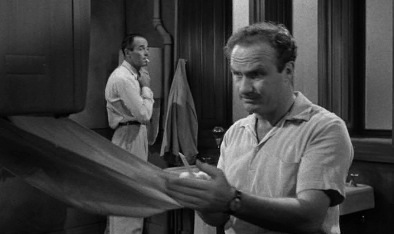
Jack Warden combs his greasy head, then proceeds to wipe the comb on the communal towel:


Henry Fonda dives in right after him like Pete Rose, smothering his face in the exact greasy spot,


then nonchalantly drying his hands as if it's the most natural thing in the world.


And maybe it is. Maybe the mollycoddlin' 21st Century has made a pantywaist germaphobe out of me, and for that I am truly ashamed.

But really, though. Communal bathroom towel? Communal sweat, grease, fluid, urine, excrement, what-have-you? I tell you, those men had reason to be angry.

All joking aside– if you haven't already, see this movie, go do it now. It may very well possess some of the finest blocking ever arranged in a constricted space and some of the more volatile (and sweaty) performances in filmdom. Pass the paper towels!

Friday, September 2, 2011

Film Review: INFERNO (1953, Roy Ward Baker)

Stars: 4 of 5.

Running Time: 83 minutes.

Notable Cast or Crew: Robert Ryan (BILLY BUDD, THE WILD BUNCH, THE DIRTY DOZEN), Rhonda Fleming (OUT OF THE PAST, SPELLBOUND), William Lundigan (PINKY, THE SEA HAWK), Larry Keating (MR. ED, WHEN WORLDS COLLIDE), Henry Hull (LIFEBOAT, HIGH SIERRA). Directed by Roy Ward Baker (A NIGHT TO REMEMBER, ASYLUM). Written by Francis M. Cockrell (RHUBARB, DARK WATERS).

Tag-line: "The wonder of 3-D STEREOPHONIC SOUND The marvel of 3-D Color by TECHNICOLOR ENHANCED A THOUSANDFOLD! The most breath-taking man hunt that ever criss-crossed out of the screen! YOU are trapped in the great Devil's Canyon of the Mojave Desert!"

Best one-liner: "Bartender, pull me a short deer!"


In a familiar alleyway, two rag-tag cineastes continue their eternal dialogue:


"Holy shit– I've just seen the damndest thing....a Robert Ryan movie in–"

–"So what, I've seen lots of Robert Ryan movies."

"Would you let me finish? A Robert Ryan movie...IN 3-D!!!"


–"3-D? What? Didn't Robert Ryan die prior to AVATAR? What, is it another 2011 Peckinpah reboot?"

"Shut that child's mouth of yours and listen to me for a minute. This is from the golden age of 3-D, and it's got class, dammit! Sure, it's occasionally got something flying straight into the lens, but above all this movie is about class. It stars Robert Ryan, for one."

–"Alright, tell me more."

"So Ryan plays a rich shitheel who's abandoned in the desert– with a broken leg and a less than intact sense of self– by his old lady and her new lover. Ryan must fight the elements to survive, and in the process, may or may not regain his inner worth as the chippy and her beau increasingly and concurrently lose theirs."

–"So it's a morality tale. I can't stand that shit."

"Ye gods! I'll speak and you'll listen! There may be ludicrous moral-dilemmas and rationalizing, backstabbin' shrews, but across the bleak desertscapes and equally barren human dwelling-places, Baker builds a characterscape of distracted modernity, a portrait of humanity whereupon we've forgotten how to humble ourselves, where none of us embrace the simple truth that it is absolutely impossible to feel important when you're stranded in the desert, up shit creek not only sans paddle, but with a broken leg, dust in your eyes, bugs in your teeth, and the infernal feeling that you're about to be created all over again by the indifferent, hazy anguish of an endless, godforsaken desert-god!


Enter Robert Ryan: laid out in the midst of the Mojave; he's outta booze and he's nearly outta bullets. So here begins his odyssey– the solitary man against impossible odds..."

–"So is it a silent movie, or is Ryan talkin' to himself?"


"Even better– Ryan delivers a genius, sardonic internal monologue throughout. His external performance possesses tremendous depth– Ryan really lets play out upon his face and body the realization that he's been abandoned to one of the most hideous deaths (dehydration and exposure followed by the carrion-eaters) in the Grim Reaper's bag-o'-tricks. His internal performance reveals a morbid sense of humor in the midst of it all, a twinkling of Robert Ryan smarminess, that kernel of jocularity that keeps him sane as he embarks on his journey."


–"Like what? Give me an example."

"Well, say, he comes across a cactus and muses 'Course that cactus is full of beer...,' begins munching on the contents, and intones 'It doesn't taste bad either! Like wet sawdust!'


Later, when going through his pockets, he withdraws a wad of currency. Flipping through the bills, he muses 'might start a fire with em.' When trying to set his broken leg between two boulders, he predicts 'This won't be jolly...' When running dangerously low on water, he takes the optimist's route: 'Fine time to be low on cigarettes...' It's all delivered with the sort of deadpan sarcasm that we're used to seeing Ryan lay down on the likes of gun-totin' punks in some film noir, but when it's turned inward, it takes on a different, even grander quality. While hunting deer he half-psychotically considers, 'Bartender– pull me a short deer!' This is just the sort of shit that's worth the price of admission alone."

–"So how does he survive? Is it like that novel HATCHET?"

"Christ, you don't get out much. Your idea of high culture is probably cruising the YA books-on-tape section at the local Goodwill."

–"Hey, I pick up some good stuff at those. BUNNICULA on two cassettes for only $1.50. But what I was asking was how Robert Ryan battles the elements."

"Well, I'm not gonna give anything major away, but two of the highlights include the following: Ryan shooting a rabbit only to have its corpse ferried off by an eager coyote, whereupon Ryan screams to the coyote (and to the heavens) 'That's my rabbit! THAT'S MY RABBIT!' Another is when Ryan chews on pebbles 'cause he seems to remember reading it in some survival guide someplace. A little research after the movie revealed that Ryan was right– apparently it tricks the mouth into thinking there's food in it, which maintains the flow of saliva, preventing the mouth from drying out too quickly, thus warding off thirst. Regardless, the entire incident only confirmed what I had long suspected: that Robert Ryan chomps rocks for breakfast."

–"Wait, though, how does the 3-D figure into this?"


"It's pretty understated, actually. The landscape is given a natural texture, and Baker allows us to sort of experience a genuine sort of vertigo at one point when foreground rock outcroppings are contrasted with the desert valley below. Often Ryan appears in 3-D against the landscape; it's an interesting visual contrast to how ill-at-ease the character is meant to feel. It remains understated, at least into the very end where some amazing late game gimmickry rears its crazed head– a lantern spirals directly into the screen, quite obviously propelled by a slow-moving invisible rope of some kind, and a fairly mind-blowing 3-D shot involving a raging inferno keeps the blood pumping till the end of the last reel.


And, like most 3-D films of the era that I've seen at the theater, there's a ridiculous intermission at the the halfway (40-minute) mark, which prompts spit- and popcorn-takes!) amongst the audience– we're just settling into the film in earnest when *BOOM*: Intermission."

–"Well, this sounds like a pretty good time."

"I knew you'd come around."

–"So how do I see it?"

"You can't."

–"Oh."

"Well, unless you stumble upon a repertory screening or some eclectic late-nite TV programming. I saw it at Film Forum in NYC. But maybe some archive collection or other will deem it fit to release (it was 20th Century Fox property, but that doesn't mean they've retained the rights). It's a good enough film to be seen in 2-D, 3-D, or whatever the hell format it happens to be in. Good luck."


-Sean Gill


Wednesday, September 22, 2010

Film Review: TERROR IN A TEXAS TOWN (1958, Joseph H. Lewis)

Stars: 4.5 of 5.
Running Time: 81 minutes.
Notable Cast or Crew: Sterling Hayden (THE KILLING, THE GODFATHER, DR. STRANGELOVE, THE ASPHALT JUNGLE), Nedrick Young (SECONDS, HOUSE OF WAX, writer of THE DEFIANT ONES, JAILHOUSE ROCK), Sebastian Cabot (THE TIME MACHINE, narrator of WINNIE THE POOH cartoons), Carol Kelly (DANIEL BOONE, TRAIL BLAZER; SUGARFOOT), Victor Millan (TOUCH OF EVIL, SCARFACE '83, GIANT), Frank Ferguson (JOHNNY GUITAR; HUSH, HUSH SWEET CHARLOTTE), Marilee Earle (THE FEARMAKERS, ISLAND WOMEN). Written by Dalton Trumbo (blacklisted writer, famed for SPARTACUS, ROMAN HOLIDAY, JOHNNY GOT HIS GUN, PAPILLON, EXODUS). Directed by Joseph H. Lewis (GUN CRAZY, THE BIG COMBO, PRIDE OF THE BOWERY, and RETREAT, HELL!).
Tag-lines: "When the Texas Plains Ran With Blood and Black Gold!"
Best one-liner: "Yes, I have killed many whales."

Let me give you the rundown:

The title: TERROR IN A TEXAS TOWN. Solid, solid alliteration. Something like TEXAS TERRORS or TERROR IN TEXAS would have been enough. And yet they went the extra step. TERROR IN A TEXAS TOWN. And yet something like TROUBLE N' TERROR IN TALCO, A TINY BUT TOUGH TEXAS TOWN would have been too much. The makers experienced exhiliration and exercised restraint. I respect that. (And readers of this site will note how much I appreciate alliteration in a movie title!)

The director: B-movie legend, Joseph H. Lewis. AKA "Wagon Wheel Joe" due to his propensity for filming shots through a wagon wheel whenever he had the opportunity. When asked about his early days as a B-Western helmer, he said "I carried a box filled with different wagon wheels. Whenever I'd come to a scene which was just disgraceful in dialogue and all, I'd place a wagon wheel in one portion of the frame, and make an artistic shot out of it, so by the time the scene was over you only saw the artistic value and couldn't analyze what the scene was about." Well, none of the scenes here are disgraceful, but, as old habits die hard, there are a lot of wagon wheels. Incredibly prolific (he directed nearly forty features from 1937-1958), he's best known for his contributions to film noir (SO DARK THE NIGHT, MY NAME IS JULIA ROSS, THE BIG COMBO, GUN CRAZY, A LADY WITHOUT A PASSPORT, CRY OF THE HUNTED, THE UNDERCOVER MAN), but his masterpiece might just be TERROR IN A TEXAS TOWN, the final feature he ever completed before moving on to a seven-year-long career in (mostly Western) television, ultimately retiring from directing in 1967.

The star: Sterling Hayden.

Ran away from home at age 15 to be a sailor– he was a ship's boy on a California-bound schooner, a Newfoundland fisherman, and a ship's fireman in Cuba. By 22, he'd sailed the world many times over, and by 24 he was a print model and a Paramount contract player christened "The Beautiful Blond Viking God" and "The Most Beautiful Man in the Movies." When the Second World War began, he enlisted as a private, became an OSS operative, parachuted into Yugoslavia, and won the Silver Star. Post-war, he resumed acting, playing notable roles in THE ASPHALT JUNGLE, THE KILLING, SUDDENLY, JOHNNY GUITAR, CRIME WAVE, and THE STAR. Acting, to Hayden, became a necessary evil- a way to earn a quick buck so he could fund his globe-trotting, seafaring, extracurricular activities.

So to play an ex-whaler, harpoon-slinging, lionhearted, 'fish-out-of-water' hero in TERROR IN A TEXAS TOWN is actually no kind of a stretch, whatsoever. (The Swedish accent, on the other hand...)

With many of the major players (writer Dalton Trumbo, stars Sterling Hayden & Nedrick Young) having personally clashed with Joseph McCarthy, it's little surprise to see that the plot revolves around the little man versus the behemoth: a rich shitheel illegally buys up a town and its sheriff so that he can easily steal the oil reserves beneath it. His henchmen intimidate, coerce, and murder those honest citizens who oppose him. A callow, doe-eyed Sterling Hayden (playing a Swede!- i.e., "I yuh-nderstand American yuh-stice, too") arrives in town to learn that his father was murdered only days before.

Optimistic Hayden.


Despondent Hayden.

Adrift in a foreign land and imbued with the same kind of fatalistic broken-English charm that Bruno S. would later exude as STROSZEK, he soon learns how things really work in America, who owns who (the sheriff says "No foreigner's gonna come in here and tell me how to run my job!"), why everyone's afraid to make a stand, and how anyone who makes a stand is quickly abandoned by their buddies and left to a gruesome fate... but maybe, just maybe, he can take up his dead father's harpoon and dispense some high-seas justice in the low-down Wild West. Joseph H. Lewis was advised against taking up the project because of the communist ties amongst the film's personnel and the picture's anti-establishment message, and curiously, he was never permitted to make another feature after this. Coincidence?

Regardess, this movie could easily be retitled (though it'd ruin the alliteration) to "STERLING HAYDEN SEZ: NO MORE BULLSHIT."

Sterling Hayden says "No more bullshit" in 1950's-safe language.


Sterling Hayden EXUDES 'no more bullshit.'

The men he goes up against are corporate oilman Sebastian Cabot (the narrator in the WINNIE THE POOH cartoons) and black-clad hired gun Nedrick Young (a blacklisted screenwriter and brilliant actor who's best described as part Richard Boone, part Claude Akins, and part Martin Landau).
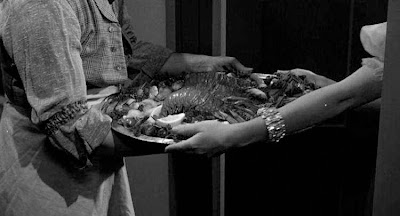

Young schemes as Cabot polishes off an entire platter of lobster.

"As long as there men like you, there'll be plenty of work for men like me," says Young's murderous 'Johnny,' who's described as "death walking around in the shape of a man." The character of Johnny, as well as his relationship with Cabot's robber baron, were clearly an enormous influence on Sergio Leone's ONCE UPON A TIME IN THE WEST- particularly the dynamic between Henry Fonda's 'Frank' and Gabriele Ferzetti's 'Morton,' right on down to the former having a businessman's aspirations after a career of hired killing. Like Frank, Johnny is an extraordinarily complex character, at times revealing himself capable of compassion, restraint, and self-reflection. Like Richard Boone's baddie in THE TALL T, you see the brutality which they mete out, firsthand- yet you sense the tortured soul, the man who begrudingly justifies his evil as a form of a survival.


Hayden tries to secure a claim on his late father's land, but comes up against the machine that is 'small-town law enforcement in a rich man's pocket.' He befriends some locals, including the young Pepe (Eugene Mazolla) and his family, which leads to the following exchange:

Pepe: "Have you killed whales?"
Sterling Hayden: "Yeh-yus. I have killed many whales-uh."
Pepe's sister: "Mister– (Pepe interrupts) I was talking to him, Pepe!"
Pepe: "Girls don't know anything about whales!"
Sterling Hayden: "Aw, now wait a minute, Pep-eh. Girls know something about al-most everything. Pear-haps even more than you and I-uh."

Hayden's making headway, but the oil magnate and his thugs- not wanting a revolution on their hands- fuck with his shit, rip up his mother's heirloom nightie, beat him down, and send him away on a train out of town. They depend on FEAR ruling the heard. But I can't comment on whether or not Sterling returns and faces off with his tormentors in an epic showdown...


In all, it's as terrific and rip-roaring a genre picture as you'd assume from the logline ("Harpoon-slinging Sterling Hayden avenges father's death!"), but it's an extremely well-written, well-acted, and well-put together film- a B-Western that stands tall amongst its A-list contemporaries- John Ford, Anthony Mann, Howard Hawks, and the like. Nearly five stars.

-Sean Gill

Tuesday, September 14, 2010

Film Review: CRY-BABY (1990, John Waters)

Stars: 4.6 of 5.
Running Time: 91 minutes.
Notable Cast or Crew: Johnny Depp, Amy Locane (SECRETARY, AIRHEADS), Susan Tyrrell (FORBIDDEN ZONE, FAT CITY, FLESH + BLOOD), Polly Bergen (CAPE FEAR '62, THE MEN), Iggy Pop, Ricki Lake (HAIRSPRAY, SERIAL MOM), Traci Lords (VIRTUOUSITY, SERIAL MOM), Kim McGuire (SERIAL MOM, David Lynch's ON THE AIR), Willem Dafoe, Joe Dallesandro (THE LIMEY, FLESH, BLOOD FOR DRACULA), Mink Stole (PINK FLAMINGOS, DESPERATE LIVING, LOST HIGHWAY), Troy Donahue (IMITATION OF LIFE, COCKFIGHTER), Joey Heatherton (BLUEBEARD, THE HAPPY HOOKER GOES TO WASHINGTON), and Patty Hearst in her fiction film debut.
Tag-lines: "Too young to be square... Too tough to be shocked... Too late to be saved..."
Best one-liner: "Let's all put on a folk hat and learn something about a foreign culture!" (said by Patty Hearst) or perhaps "Woo-Wee, you caught me in my birthday suit, butt-naked" (said by Iggy Pop).

Psuedo-commercial John Waters (PECKER, SERIAL MOM) is not necessarily better than shoestringy, gutter sleaze John Waters (FEMALE TROUBLE, DESPERATE LIVING), they're just different- much like, say, the difference between TWIN PEAKS-Lynch and INLAND EMPIRE-Lynch. Some artists flourish under constraints (you can't show Divine devouring dog stools or Liz Renay getting rabies in the ass in a PG-13 film), and Waters is creative enough to make a film which nominally pleases the mainstream, yet is still deliciously infested with his trademarked pervy pizazz. This film is an oddball tour de force of sheer, ludicrous delights from a tittering, perfidious sewer rat to a devout Joe Dallesandro zealously bellowing "Let Jesus Christ be your gang-leader!" into a megaphone (as Joey Heatherton shudders beside him in a pious frenzy)-

In short, CRY-BABY is the bee's knees. It's Drapes vs. Squares, forbidden love, a 10th-rate Baltimore Disneyland, rockabilly concerts, an orphanage jailbreak, an epic “chicken” duel and an amalgamation of everything that Waters loves about the 1950's from JAILHOUSE ROCK to TEENAGE GANG DEBS.


The bizarro performances range from the hammy to the outré. Johnny Depp transforms the act of frequent, stoic weeping into something worthy of Tiger Beat magazine.

The legendary Susan Tyrrell (FAT CITY), while wearing a taxidermy bird helmet, sputters and chortles and emotes and blows away "goddamn gophers." It’s a work of mad genius and truly a sight to behold.

Tyrrell's trademark cackle.


Tyrrell and Pop. Best onscreen couple since Tyrrell and Rutger Hauer in FLESH + BLOOD. Who were the best onscreen couple since Tyrrell and Hervé 'Ze Plane' Villechaize in FORBIDDEN ZONE. Who were the best onscreen couple since Tyrrell and Stacy Keach in FAT CITY.

Iggy Pop is her husband, bathing himself in a wooden tub on the lawn and being an all-around good sport. Amy Locane embraces a sort of 'young Kathleen Turner' aesthetic, and Waters' two favorite pariahs (Traci Lords and Patty Hearst) exude, respectively, pose-worthy sass and adorable gullibility. Mink Stole speaks in tongues, and there's a 3-D moviegoing experience that'd make William Castle proud:

Willem Dafoe even appears for an ass-slapping cameo as a sleazoid, country-drawlin' prison guard.

"We gonna give you a haircut, pretty boy!"


By gum, this shit is great. Nearly five stars.

-Sean Gill