Pages

Blogger templates

Blogroll

Labels

Featured 1

Curabitur et lectus vitae purus tincidunt laoreet sit amet ac ipsum. Proin tincidunt mattis nisi a scelerisque. Aliquam placerat dapibus eros non ullamcorper. Integer interdum ullamcorper venenatis. Pellentesque habitant morbi tristique senectus et netus et malesuada fames ac turpis egestas.

Featured 2

Curabitur et lectus vitae purus tincidunt laoreet sit amet ac ipsum. Proin tincidunt mattis nisi a scelerisque. Aliquam placerat dapibus eros non ullamcorper. Integer interdum ullamcorper venenatis. Pellentesque habitant morbi tristique senectus et netus et malesuada fames ac turpis egestas.

Featured 3

Curabitur et lectus vitae purus tincidunt laoreet sit amet ac ipsum. Proin tincidunt mattis nisi a scelerisque. Aliquam placerat dapibus eros non ullamcorper. Integer interdum ullamcorper venenatis. Pellentesque habitant morbi tristique senectus et netus et malesuada fames ac turpis egestas.

Featured 4

Curabitur et lectus vitae purus tincidunt laoreet sit amet ac ipsum. Proin tincidunt mattis nisi a scelerisque. Aliquam placerat dapibus eros non ullamcorper. Integer interdum ullamcorper venenatis. Pellentesque habitant morbi tristique senectus et netus et malesuada fames ac turpis egestas.

Featured 5

Curabitur et lectus vitae purus tincidunt laoreet sit amet ac ipsum. Proin tincidunt mattis nisi a scelerisque. Aliquam placerat dapibus eros non ullamcorper. Integer interdum ullamcorper venenatis. Pellentesque habitant morbi tristique senectus et netus et malesuada fames ac turpis egestas.

Showing posts with label 60's. Show all posts

Wednesday, January 22, 2014

Only now does it occur to me... THE MIRACLE WORKER

Only now does it occur to me...  that the nearly nine-minute knock-down drag-out brawl between Annie Sullivan and Helen Keller (as the former attempts to pierce the abyss and teach the latter table manners) is probably the most brutal, drawn-out skirmish between stubborn personalities... until the spectacular six-minute fistfight from THEY LIVE.


The scenes are both so brilliantly blocked, staged, and acted (in THE MIRACLE WORKER, Anne Bancroft and Patty Duke directed by Arthur Penn; in THEY LIVE, "Rowdy" Roddy Piper and Keith David directed by John Carpenter) that they really stick out in one's mind as special, a beautiful fusion of stage and screen sensibilities.


The actors are permitted to reach into a deeply primal well as the scene is simplified and streamlined into two visceral, battling motivations:  "Eat with a utensil" & "I refuse!", and "Put on the glasses!" & "No!," respectively.


In each case, words take a back seat to action, and the result is raw, powerful, and riveting.  The scenes' length plays a role, too: as the characters clash beyond the point of reason and into pure obstinance/force of will, a dark humor emerges that somehow only intensifies the scene.  I think any director or actor should find a lot to learn here.

Thursday, November 14, 2013

Film Review: THE SANDPIPER (1965, Vincent Minnelli)


Stars:  2 of 5.
Running Time:  117 minutes.
Tag-line: "She gave men a taste of life that made them hunger for more!"
Notable Cast or Crew:  Elizabeth Taylor, Richard Burton, Eva Marie Saint, Charles Bronson.  Written by Martin Ransohoff (producer of THE FEARLESS VAMPIRE KILLERS, CATCH-22), Irene Kamp (THE BEGUILED), Louis Kamp (MR. QUILP), Michael Wilson (PLANET OF THE APES, THE BRIDGE ON THE RIVER KWAI), and Dalton Trumbo (SPARTACUS, JOHNNY GOT HIS GUN).
Best One-liner:  "What would you do, in my shoes?"  –"Wear them!"

THE SANDPIPER is a mostly torpid romantic drama featuring star-crossed dipsomaniacs Liz Taylor and Richard Burton being directed by the legendary Technicolor dream-master Vincent Minnelli.  It's got some nice nature photography, but then again, so does ROBOT MONSTER.  So, here's a list of my favorite things that Charles Bronson does in it:

#1.  Bronson is real hip to your jive, daddy-o.  That's right:  Charles Bronson is playing a beatnik.  A loud-mouthed Bohemian-by-way-of-Big-Sur liberated artsy know-it-all.
And check it out, there– he's totally doing the arm motion from the "It's MY car!" scene in DEATH WISH 3!
It's MY car!

Talk about goin' through the rabbit hole:  Bronson's playing the sort of hilariously stereotyped youth-subculture ne'er-do-well that he'd later spend large chunks of the 1970s and 80s gunning down in the street!

#2.  Bronson the sculptor.  So Beatnik Bronson's artistic discipline happens to be sculpture.  And sculpt he does:  specifically, he sculpts a nude wooden Liz Taylor while Richard Burton (playing a lovestruck Reverend) paces around uncomfortably.
Given the context I'm used to seeing Bronson in, this is fairly bizarre and absolutely welcome.  Though it's worth noting that even Bronson's "sensitive artist" is a brawny guy who spends most of the film tangling with and harassing outsiders.

#3.  Bronson, the drug addict.  Being a bongo-n-beret-luvin' Beatnik with loose morals and declining character and grumble, grumble would you believe kids these days grumble, grumble:  Bronson naturally acts like a total dick to the Reverend Richard Burton and starting talking about heroin ("H", to use Bronson's parlance) like it's no big deal and

wondering if God lives inside his hypodermic.  Again, it's amazing in context– twenty years later, he'd be flinging a bag of crack in a dealer's face and saying "How many children have you killed with this shhhhhitttt!" while unleashing a hail of bullets.

#4.  Bronson, Liz Taylor smoocher.   As the film develops, Bronson briefly becomes a sort of romantic rival to Richard Burton, and even sneaks a smooch.
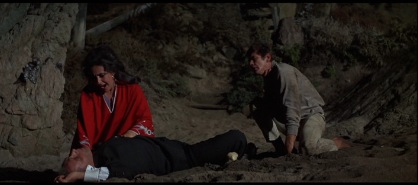
Later, they duke it out and Burton proceeds to kick Bronson's ass

but then Bronson gets back up to have the last word and knocks Burton out.

So there's your schoolyard hypothetical "what would happen if Bronson and Burton had a fistfight?" played out on screen.

#5.  Bronson, the man who leans on things.  If there's anything around to lean on, anything at all, Bronson makes the acting choice... to lean on it.


He is simply a man who leans on things.  I would like to believe that he wasn't just feeling lazy, and that in fact this was a conscious acting choice–  hell, maybe it's Bronson's take on the Beatnik generation:  too namby-pamby to stand up straight on their own, or something.  I don't know.  

Anyway, even all this Bronson greatness (in what amounts to three brief scenes in a nearly two hour movie) can't come close to savin' this weird-n'-jazzy, pre–"Summer of Love" snoozer.  Two stars.

–Sean Gill

Monday, May 27, 2013

Book Review: THREE BAD MEN: JOHN FORD, JOHN WAYNE, WARD BOND (2013, Scott Allen Nollen)


I'm a longtime fan of John Ford (who isn't, really?), the patron-saint of Monument Valley, born-again Irishman, and director of some of the best-constructed, most thoughtful films to come out of Hollywood, from THE INFORMER to THE MAN WHO SHOT LIBERTY VALANCE to THE QUIET MAN to THE GRAPES OF WRATH.
John Wayne is, so to speak, John Wayne, though his work frequently transcends the "movie star" mold with a dancer's grace and a touch of madness like in Ford's THE SEARCHERS, Hawks' RED RIVER, and Siegel's THE SHOOTIST.
Then, there's Ward Bond: a character actor extraordinaire who played brutes and cowpokes and priests and boxers across more than two hundred films.  Though his supporting work with Ford and Wayne is why he's included in this trio, my soft spot for him will always be his one and only shot at top-billing in 1942's HITLER: DEAD OR ALIVE, a film that clearly inspired INGLOURIOUS BASTERDS and contains the fabulous spectacle of Ward slapping the shit out of Hitler himself ...before proceeding to force-shave off his mustache! 

Anyway, I just finished reading Scott Allen Nollen's in-depth examination of the lives and work of these three cinematic giants, and I highly recommend it as a fascinating study for burgeoning old-Hollywood aficionados and serious fans of cinema alike.  Chronologically tracing the intertwining lives of these three "good-bad men" who were not unlike the characters in their films (Ford directed Bond and Wayne in nearly thirty pictures each), Nollen is at once objective and affectionate in his analysis, and there's a wealth of source material including documents, letters, telegrams, and plenty of rare photographs.  There are riveting anecdotes (I may now actually be inspired to read Harry Carey, Jr.'s autobiography), some great yarn-spinning (including tales of Ward Bond's brutish, high-flying, indecent-exposing, Wile E. Coyote-style antics and his ruining of a key scene in THE SEARCHERS when he unplugged the camera to plug in his electric razor!), and the work definitely touches on their peccadillos and absurdities, though never salaciously.

It's deftly written and never dry; while many books of this kind become bogged down by academic posturing, Nollen remains true to the spirit of his subjects and opts for a two-fisted, no bullshit approach.  I really appreciate how deeply he throws himself into the work, freely admitting "a meaningful (though a bit one-sided) conversation with a tombstone or two."  He's as a film writer should be– intense, obsessive, and highly-focused; reverent without succumbing to hollow adulation.

The main drive of the work is the examination of the complex personal and working relationship between the three (though large swaths of the book are dedicated to advancing the underrated Ward Bond to his rightful place in the pantheon).  None of these men could really be pinned down or branded with a particular stereotype– each had a volatile mix of id and ego (often sprinkled heavily with alcohol) that fused together to create a kind of perfect storm of filmic art. 
The complex psychology of Ford's relationships with the two men is indeed worthy of an entire volume– you see a strange kind of ownership emerge, resulting from Ford's "discovering" of the two actors.  This ownership was generally expressed in verbal (and often physical) sadism as Ford became master of his "whipping boys," something which may have even tied into his potential bisexuality:
"Ford loved John Wayne and Ward Bond, but his true sexual orientation wasn't something he would have discussed with them, or anyone else.  When it came to his own life and psyche, Pappy [Ford] avoided the truth, exaggerated, lied, or just didn't 'have any goddamn idea.'  The positive emotions he felt for his two favorite actors and whipping boys may have been the underlying cause of his negative, sadistic treatment of them (and himself); but even a lifetime of psychoanalysis may not have 'proved' anything."
Vindictive and controlling, Ford "froze out" Wayne for eight years when he appeared in a rival director's Western (Raoul Walsh's THE BIG TRAIL) and later, when Bond made serious forays into television (WAGON TRAIN) and Wayne tried to direct a picture of his own (THE ALAMO), Ford would sometimes install himself as a presence on set and attempt to undermine/co-opt the work therein.  These behaviors even extended beyond the trio– he punched out Henry Fonda (!) on MISTER ROBERTS and made cruel, deliberate use of alcohol to wring earth-shattering, hungover performances out of the likes of Victor McLaglen in THE INFORMER and Woody Strode in SERGEANT RUTLEDGE.

Though he reveals these men "warts and all," Nollen also paints a portrait of devoted friends and masterful artists whose lives and creative outlets meshed almost completely.  (For instance, despite the abuse, Ford chose Bond to play his own alter-ego in the deeply personal THE WINGS OF EAGLES.) 

Nollen takes on the accusations of racism in Ford's films, and reveals his struggle to show all sides despite the constraints of the system– especially evident in films like THE SEARCHERS, SERGEANT RUTLEDGE, and CHEYENNE AUTUMN.  He tackles the strange political spectrum of the men, too, with John Ford's patriotic progressivism, Wayne's conservatism, and Ward Bond's ultraconservatism (and yet it was Ford who took his camera overseas into the crucible of World War II while Wayne and Bond remained in Hollywood).  He doesn't shy away from Ward Bond's shameful behavior in the McCarthy era as a supporter of the blacklist:
"The social climbing Bond's ultimate political affront to Ford involved an invitation to a party he was throwing for Senator Joseph McCarthy.  His great mentor [Ford] simply answered, 'You can take your party and shove it.  I wouldn't meet that guy in a whorehouse.  He's a disgrace and a danger to our country.'"
Bond's involvement with the blacklist feels like a moral counterpoint to Ford's extensive work with the U.S. armed forces in World War II and beyond, and much attention here is paid to his military career (I learned that in North Africa a Nazi actually surrendered himself to John Ford!) 

Along the way, Nollen delves into a vast spectrum of material including Ford's relationship with his older brother Francis (mentor, actor, and silent film director), Ford's gleeful propensity for Chaucer/Shakespearean-style low comedy and his hilariously bizarre obsession with highlighting Ward Bond's "horse's ass" in shot compositions ("Although FORT APACHE is a serious examination of the mythology of the American West, it humorously can be branded Ford's 'ass-travaganza'").  Of particular interest to me were Ford's work with Victor McLaglen (whose performance in THE INFORMER is one of the greatest in filmdom), his direction of genius child actor and later genre-movie legend Roddy McDowall in HOW GREEN WAS MY VALLEY,  Bond's artistic process as unofficial show-runner on WAGON TRAIN, and the compelling, touching latter-day friendship between Ford and Woody Strode– and the book certainly has some genuinely emotional, poignant moments as the three "good-bad" men's lives dwindle to a close.

In the end, it definitely gets you amped up to watch some John Ford films– I've probably seen at least two dozen or so at this point, but there's still scores more I need to get my hands on, and there's obviously some big gaps in my knowledge.  For instance, since I've read THREE BAD MEN, MISTER ROBERTS, THEY WERE EXPENDABLE, 3 GODFATHERS, and WAGON MASTER have now leapt to the forefront of my queue.

THREE BAD MEN is published by McFarland (Order line: 800-253-2187), ISBN 978-0-7864-5854-7

Monday, May 6, 2013

Only now does it occur to me... BLOOD BATH

Only now does it occur to me... that Sid Haig has played basically every ethnicity, at one time or another.

BLOOD BATH is a fairly terrible, but fairly watchable Roger Corman clusterfuck with an exceptionally convoluted production history that involved a Yugoslavian spy thriller, a Venice Beach-set vampire flick, co-financing by Roger Corman and Stephanie Rothman, co-direction by the legendary Jack Hill (COFFY, THE BIG BIRD CAGE, SPIDER BABY, FOXY BROWN) and Rothman, music (predictably) stolen from DEMENTIA 13, and all sorts of other random and bewildering things.  You can read about the absurdly labyrinthine twists and turns of the production here.

Also, it features one of the worst-looking vampires ever:

But that's not the point of this entry– the point is the hilarious spectrum of quasi-ethnic roles that have been played by Sid Haig.  Here, he plays a beatnik named "Abdul the Arab."
  
 Haig (far right) in a well-constructed community theater vest)


Haig (second from left) placing a close 2nd in the scene-chewing contest of this particular tableau

From what I've read, he's actually Armenian-American, but in other fine films he's played Hispanic (THE FIREBRAND, IRON HORSE, THE FLYING NUN, CHE!, MISSION: IMPOSSIBLE), Native American (DANIEL BOONE), Italian (THE MAN FROM U.N.C.L.E., DIAMONDS ARE FOREVER, MISSION: IMPOSSIBLE), Turkish (GET SMART, OHARA), Arabian (BLOOD BATH, THE DON IS DEAD, SWITCH, FANTASY ISLAND, MACGUYVER),  Russian (MISSION: IMPOSSIBLE), South American Indian (THE FORBIDDEN DANCE IS LAMBADA), Ambiguous Asian (BRING 'EM BACK ALIVE), and just plain "Swarthy" (MISFITS OF SCIENCE).  And I'm certain there's dozens I've missed or haven't seen.  Whew! Well done, Mr. Haig– you truly are a one man "It's a small world (after all)."

–Sean Gill

Thursday, April 4, 2013

Film Review: CAPE FEAR (1962, J. Lee Thompson)


Stars: 5 of 5.
Running Time: 105 minutes.
Notable Cast or Crew:  Gregory Peck, Robert Mitchum, Martin Balsam (PSYCHO, DEATH WISH 3), Telly Savalas (KOJAK, VIOLENT CITY), Polly Bergen (THE WINDS OF WAR, CRY-BABY), Lori Martin (THE CHASE, NATIONAL VELVET the TV series), directed by J. Lee Thompson (THE GUNS OF NAVARONE, DEATH WISH 4: THE CRACKDOWN).  Screenplay by James R. Webb (HOW THE WEST WAS WON, THE BIG COUNTRY), and adapted from the novel by John D. MacDonald.
Tag-line: "Their ordeal of terror triggers the screen's most savage war of nerves!"
Best one-liner:  "I got somethin' planned for your wife and kid that they ain't nevah gonna forget.  They ain't nevah gonna forget it, and neither are you, counselor.  Nevah!"

If you haven't seen CAPE FEAR (the '62 original), then by all means, see it immediately.  It's a brutal, Hitchockian thriller (with a nightmarishly evocative Bernard Herrmann soundtrack) that contains one of filmdom's great villains and possesses a jaw-dropping mean streak that's somehow only amplified by the production code's constraints against explicit sex or violence.  Now, today's review is going to mostly be a screen capture tribute dedicated to the sleaze and sadism of super-scary Bob Mitchum, but I have a little housekeeping to do first.  

First, a note about the director:  J. Lee Thompson was an English playwright and filmmaker-craftsman whose most respected productions are probably CAPE FEAR and THE GUNS OF NAVARONE, both from the early 60s.  He went on to direct the latter two of the five original PLANET OF THE APES films, and in 1976, with ST. IVES, began a treasured nine-film collaboration with the one and only Charles Bronson.  His career ended with a stint as a resident director at Cannon Films, and eight out of his nine final films were released under the glorious Cannon banner.  He went out with the bang that was KINJITE: FORBIDDEN SUBJECTS.

Second, I have to point out the wonderful piece of trivia that Ernest Borgnine was the first choice for the role (the villainous Max Cady) which would ultimately go to Mitchum.   We totally could've been looking at this:
(as seen in FROM HERE TO ETERNITY)
instead of this.  Now, I think Mitchum is the right choice, but make no mistake– I'd watch the hell out of a Borgnine CAPE FEAR.

Third, there's a conversation between newly-sprung convict Mitchum and the lawyer who testified against him (Gregory Peck) whereupon Mitchum begins to muse about exactly how much money each incarcerated year of his life might be worth.  Fans of the first season of TWIN PEAKS will recognize it as near-verbatim inspiration for a similar scene between Hank Jennings (Chris Mulkey) and Josie Packard (Joan Chen) as they discuss his post-prison future.

But that's enough talk– onward to a pictorial collage of Bob Mitchum guaranteed to curdle your blood and curl your hair.  I call it, "THINGS ABOUT WHICH BOB MITCHUM GIVES A DAMN AND THINGS ABOUT WHICH BOB MITCHUM DOES NOT GIVE A DAMN ."

BOB MITCHUM DOES NOT GIVE A DAMN IF HE WRECKS YOUR BOWLING SCORE


BOB MITCHUM DOES NOT GIVE A DAMN IF YOU ARE MARRIED

AND BOB MITCHUM  DOES NOT GIVE A DAMN ABOUT INSINUATING THAT YOU ARE A PROSTITUTE


BOB MITCHUM DOES NOT GIVE A DAMN ABOUT SECOND-HAND SMOKE

BOB MITCHUM DOES NOT GIVE A DAMN IF HE MAKES YOU UNCOMFORTABLE BY WEARING NOTHING BUT GIANT OLD MAN UNDIES AND A PANAMA HAT

BOB MITCHUM DOES NOT GIVE A DAMN ABOUT KILLING YOU WITH HIS BARE HANDS, SLOW

AND HE DOES NOT GIVE A DAMN ABOUT YOUR PRETENTIOUS INSULTS

BOB MITCHUM DOES NOT GIVE A DAMN ABOUT PERFECTING HIS BAR SLOUCH

BOB MITCHUM DOES NOT GIVE A DAMN ABOUT LYING TO AIRLINE EMPLOYEES


BOB MITCHUM DOES NOT GIVE A DAMN ABOUT CHECKING OUT YOUR TEENAGE DAUGHTER


AND BOB MITCHUM DOES NOT GIVE A DAMN THAT HIS BEER IS WARMER THAN ROOM TEMPERATURE

BOB MITCHUM DOES NOT GIVE A DAMN IF YOU DON'T LIKE BEING DROWNED
AND HE DEFINITELY DOES NOT GIVE A DAMN ABOUT GETTING WET

BOB MITCHUM DOES NOT GIVE A DAMN, IN GENERAL

 HE JUST DOES NOT GIVE A DAMN.

Interesting. Oh, so I guess my title was a bit of a misnomer, since Bob Mitchum does not appear to give a damn about anythin–

BOB MITCHUM GIVES A DAMN ABOUT PEANUTS

Five stars.  And I'll grab some salted peanuts for you, Bob– in the shell.


-Sean Gill