Pages

Blogger templates

Blogroll

Labels

Featured 1

Curabitur et lectus vitae purus tincidunt laoreet sit amet ac ipsum. Proin tincidunt mattis nisi a scelerisque. Aliquam placerat dapibus eros non ullamcorper. Integer interdum ullamcorper venenatis. Pellentesque habitant morbi tristique senectus et netus et malesuada fames ac turpis egestas.

Featured 2

Curabitur et lectus vitae purus tincidunt laoreet sit amet ac ipsum. Proin tincidunt mattis nisi a scelerisque. Aliquam placerat dapibus eros non ullamcorper. Integer interdum ullamcorper venenatis. Pellentesque habitant morbi tristique senectus et netus et malesuada fames ac turpis egestas.

Featured 3

Curabitur et lectus vitae purus tincidunt laoreet sit amet ac ipsum. Proin tincidunt mattis nisi a scelerisque. Aliquam placerat dapibus eros non ullamcorper. Integer interdum ullamcorper venenatis. Pellentesque habitant morbi tristique senectus et netus et malesuada fames ac turpis egestas.

Featured 4

Curabitur et lectus vitae purus tincidunt laoreet sit amet ac ipsum. Proin tincidunt mattis nisi a scelerisque. Aliquam placerat dapibus eros non ullamcorper. Integer interdum ullamcorper venenatis. Pellentesque habitant morbi tristique senectus et netus et malesuada fames ac turpis egestas.

Featured 5

Curabitur et lectus vitae purus tincidunt laoreet sit amet ac ipsum. Proin tincidunt mattis nisi a scelerisque. Aliquam placerat dapibus eros non ullamcorper. Integer interdum ullamcorper venenatis. Pellentesque habitant morbi tristique senectus et netus et malesuada fames ac turpis egestas.

Showing posts with label John Cassavetes. Show all posts

Thursday, June 9, 2011

Junta Juleil's Top 100: #95-#91

95. ONLY ANGELS HAVE WINGS (1938, Howard Hawks)

I'm not sure anyone has ever matched the skill with which Hawks integrated exposition, character development, and sheer entertainment. He makes it look so damned easy, too. He often sets up a situation where men are doing a serious job, a dangerous job, and then events simply unfold. As they unfold, we learn everything we need to know about the characters because we've been there with them, in the trenches, seeing how far they can be pushed, and how hard they can push back. You don't feel as if you're watching something contrived by sheltered Hollywood-types, because it's not– he's incorporating details, the way his men act under pressure, the way he directs a picture, even, from his real-life experiences as an aviator, a race-car driver, an army man, and a factory worker. This is the sort of film to which I give my highest recommendation; I don't even think I have to tell you about the plot. Just another one of his immaculately constructed tales of men's men and ladies who pull no punches. Did I mention that Hawks' middle name was WINCHESTER?

94. MAKE WAY FOR TOMORROW (1937, Leo McCarey)

"It would make a stone cry."
–Orson Welles.
Sweet God in heaven, I'm not sure that any movie has ever jerked as many tears from its audiences, per capita, as MAKE WAY FOR TOMORROW. Leo McCarey, who won a Best Director Oscar the same year for the well-made, but far lesser film THE AWFUL TRUTH, said in his acceptance speech: "Thanks, but you gave it to me for the wrong picture." It'd be a difficult movie for audiences to 'enjoy' in any time or place because it asks difficult questions about the relationship between parents and their children; how we care for them, how they cared for us, and what fate is to be earned for all "as the long day wanes." Victor Moore and Beulah Bondi play the elderly couple at hand, delivering a couple of the most purely, emotionally reactive performances in the history of the medium. The clock ticks, the children wait, and the old couple relive youthful memories, a moment of respite before moving on. Dr. Samuel Johnson said it better than I ever could: "We never do anything consciously for the last time without sadness of heart..." And so I join the ranks of viewers who find themselves grasping for the telephone as the final reel ends, calling up loved ones, contemplating these fleeting moments, and hoping for the chance to have more of them.

93. ROSEMARY'S BABY (1968, Roman Polanski)

From producer William Castle– yeah, you heard me right!– comes one of the finest horror films of the 1960's, or of any other era. Castle recognized his dramatic limitations (handing the reins ultimately to master of claustrophobic/metropolitan/conspiracy-horror, Roman Polanski), but he does show up for a brief, wordless, yet somehow amazingly hammy cameo during the phone booth scene. Regardless, this is really Polanski's film, and he spins the tale with paranoid gusto and eye-popping imagery; swirling, hallucinogenic dream sequences and off-kilter quotidian happenings. It's a hotbed of primal fears and existential dread: Polanski has got his finger on just the right nerve, and he plucks and twangs it unceasingly– rape, domestic terrors, body horror, the things we try to hide, the things we don't understand, our fear of doctors and the elderly and babies and enclosed spaces and antiquarian objects and of failure and of seeming crazy and of going crazy; and it all begins to collapse upon you like a black hole and a cry unto the pit– SWEET GOD, WHAT A MOVIE!!!
Also, Ruth Gordon and Sidney Blackmer are just about the most adorably frightening and frighteningly adorable elderly actors I've ever seen (not to be confused with the elderly actors from #94!). And I have to say that John Cassavetes' "I didn't want to miss baby night" has got to rank as the most hilariously inappropriate excuse ever uttered, on or off a camera. (You'll know what I mean if you've seen the film– yikes!)

92. FAIL-SAFE (1964, Sidney Lumet)

It's difficult to incorporate methodical, systematically structured storytelling with genuine emotional stakes, but goddamn, does Lumet pull it together, and with the fate of the human race in the balance, no less! Most prefer DR. STRANGELOVE, which is sort of a loose, parodic retelling, but for my money, FAIL-SAFE's the stronger film. Some have said that STRANGELOVE's satire cuts to the bone, but I say FAIL-SAFE cuts to the bone, then fractures the bone, and then looks down at the bone, somberly, as tears well up in FAIL-SAFE's eyes. FAIL-SAFE then clenches its jaw; anguished, but with an abundance of dignity. As a side note, by and large, though your average fictional president is more appealing than your average actual president, I have to say that Henry Fonda's portrayal in this film goes beyond that– he is so sincere, so thoughtful, so determined, so damned invested, that you wish he really was the president. Also: Dom DeLuise in a serious role– chew on that for a little while.

91. BIG TROUBLE IN LITTLE CHINA (1986, John Carpenter)

"Have you paid your dues, Jack– yessir, the check is in the mail." I've written a few observations about BIG TROUBLE IN LITTLE CHINA before, saying "it's about the exhilaration of being ALIVE in a world of unfathomable mystery," and, of Kurt Russell's performance, "he's a runaway train of swagger, guts, and bluster...I never tire of his maniacally youthful cackle, or his proclivity toward moaning 'Awwwwww, CHRIST!'" In short, it's one hell of a time, written, directed, and performed by artists and craftsmen who are having one hell of a time. But it's no mindless shoot-em-up: it's a Hawksian ode to the bonds of friendship, the measure of character, and those ecstatic moments of temerarious action, where, against all better judgment, you feel damn near invulnerable. (Also, you just drank from the six-demon bag.) And, while we're at it, how 'bout that kickin' song over the end credits?


Coming up next...
George Romero's favorite movie, a legendary documentary, and... a movie with a lesser Baldwin!

Thursday, December 2, 2010

An Evening with Golan & Globus


Devotees of this site have long heard me pontificate upon the Cannon films of Golan and Globus, and recently, you've probably heard me prattling about the Cannon Films Canon at Lincoln Center, which I was lucky enough to attend on the weekend of November 19th. Said weekend involved the screening of many a Cannon gem (with the selection of arthouse films overshadowing the zanier flicks of the catalog). In my recent review of BARFLY, I wrote a bit about the post-screening Q&A, which involved Barbet Schroeder, Tom Luddy, Yoram Globus, and Menahem Golan. The next day, I was privy to a double-feature of RUNAWAY TRAIN and THE APPLE which included an hour-long discussion between Golan and Globus, and a sort of disco-themed afterparty whereupon these titans of cinema (and APPLE star Catherine Mary Stewart) were assailed by drunken blowhards and die-hard fans alike as the thrumpin' sounds of ABBA eschewed all traditional audibility. In short, it was pretty fantastic. So I thought I'd write up some of the more compelling moments of the evening and share them with the Cannon fans of the world. (And see the end of the BARFLY review as a sort of 'Part 1' to this article).

Even though I'd seen it before, RUNAWAY TRAIN is something to behold on the big screen- scraping steel, snowy vistas, blood and oil and grease and steam. The sheer, absolutely brutish intensity of Jon Voigt and John P. Ryan is mind-blowing- we see men become animals, we see animals become men. The unexpected touches of comedy are even better with a crowd, too- from insults about "your momma's farthole" to the swishy, hot-pants-wearing prison boxing ring cheerleader to John P. Ryan dunking a man's head in the toilet and telling him to "clean the piss off your face!" After the screening, Golan & Globus revealed that it is their favorite of all their films, and began a moderated discussion which jumped to and fro, from the serious to the absurd to the sublime. Since there was no true direction to the chat, I'll tackle random, salient points.

Golan (left) and Globus (right) during Cannon's heyday.

On Andrei Konchalovsky (Cannon alumni- MARIA'S LOVERS, RUNAWAY TRAIN, SHY PEOPLE):
–Golan said he was always demanding costly shots that ended up eating up significant amounts of the total budget, but then weren't used by Konchalovsky in his final cuts! These included a life-size electric whale on SHY PEOPLE and a barnburnin' flyby under a bridge in MARIA'S LOVERS. But despite some difficulties and even a helicopter crash on RUNAWAY TRAIN, Golan & Globus still sit in breathless amazement at the aerial shots Konchalovsky managed to capture. Golan: "I worry about this train in every shot– how did they do it?!"

On Tobe Hooper (Cannon alumni- TEXAS CHAINSAW MASSACRE 2, INVADERS FROM MARS, LIFEFORCE):
–They had nice things to say about Tobe, bragged about the technical achievements of LIFEFORCE, and Golan said that he was 'too scared' to ever watch TEXAS CHAINSAW 2 in its entirety!

On John Cassavetes (Cannon alumni- LOVE STREAMS):
–They had troubles with his first cut of LOVE STREAMS. It didn't quite flow right, and felt a little long. They asked John if perhaps he could lose about 15 minutes. Instead, John added 40, insisting that "it doesn't matter because now it feels shorter." Of course, being relentlessly pro-director producers (even to the point of their own detriment, on occasion), they released the 141 minute long cut.

On Golan's ENTER THE NINJA:
–They bragged about the $1.5 budget, and Globus proudly proclaimed that "Menahem invented the ninja movie!"

On BREAKIN':
– Golan: "I was on the beach in Venice and I saw the black people doing a dance I have never seen before...and so we made BREAKIN'." Golan explained that he brought the finished print to MGM, who was to distribute the film in the U.S. MGM brass watched the film in disgust, claiming it was a "schwarze movie only for the blacks." Golan defended it with that patented Cannon moxie, and demanded another screening- this time with an audience of real people plucked from the streets, not just MGM stuffed shirts. Cannon secretly recruited street dancers for the screening who, once the film had begun, erupted into impromptu windmills, applejacks, kip-ups and worms in the aisles, wowing the excutives and giving Cannon the greenlight!

Globus on Golan (the two haven't been seen together in 20 years!):
–"There is no greater storyteller than Menahem."
–"He is a Globus, he betrayed and became a Golan!" (Menahem changed his name to Golan for patriotic reasons while in the Israeli air force in the late 40's.)
–"The best salesman in the world."

On their youthful days:
–Golan and Globus always loved movies, ever since they were children, but Globus never had any aspirations to actually making them- he just wanted to watch them (he worked as a projectionist in high school). Golan had some grand plans and instructed Globus to go to business school and return, and then they'd take the world by storm– and indeed they did!

On Chuck Norris:
–Golan: "We signed him to a seven-year contract. It was like the golden days of Hollywood."

On Charles Bronson:
–Golan: "He hated the press appearances and the PR"- but they made him do 'em anyway! –Golan: "I wouldn't say that he was a theater actor. On the screen sort of like a great fish." [I have no idea what this means, if I misheard Golan, or if perhaps in some roundabout way he meant to compare Bronson's squint and facial hair to that of a catfish?]

On THE APPLE:
–There was some amazing bickering between G & G about the exact budget of THE APPLE, they finally decided that it cost $5 million.
–On a serious note, Globus told the following story as Golan solemnly nodded in concurrence: at an early screening of THE APPLE in Montreal, the French-Canadian crowd booed the film throughout. After the screening, Golan was nowhere to be found– he was discovered on the roof of his hotel, contemplating suicide. He spoke with Globus, and came down soon after. At this point, Golan commented to us all: "Not everybody likes the movie." [Who could have forseen that thirty years later, he'd be presiding over a screening in New York City packed with psychotic, BIM-marked APPLE die-hards?]

On directorial freedom:
–Golan believed in complete artistic freedom, Globus, generally speaking, did not. On MASTERS OF THE UNIVERSE, spiraling out-of-control budgets and weak dailies made Globus want to fire director Gary Goddard. Golan refused ("I have never fired a director."). Of course, the film ended up being a terrible flop and another nail in Cannon's coffin, but Golan still stands by the decision.

On television in Europe:
–Golan: "At any moment, any day, any time of day, you can flip the channels and find playing a Cannon film!"

On 'will they ever work together again?':
–Golan revealed that he's trying to pitch to Globus a new project, and perhaps, one day soon, we will see a new movie emblazoned with that glorious "Golan-Globus" banner! Globus sort of half-smiled and, while not ruling anything out, clarified that to say anything would be premature. Golan proceeded to explain that it would be a simple New York City story called THE SNIPER. Or possibly a romantic comedy called I LOVE MY WIFE.

On Jean-Claude Van Damme:
–Golan: "I discovered the bastard." Apparently Golan was eating at a Los Angeles restaurant when a young waiter, carrying three bowls of soup on a tray approached him. 'Are you Menahem Golan, the producer?' the young Belgian asked. 'Yes, I am,' Golan replied- whereupon young Van Damme spun his leg above his head without spilling a drop of the soup. Impressed with the limber limbs of the Muscles from Brussels, Van Damme appeared as an extra in Cannon films like BREAKIN' and MISSING IN ACTION, and later got his chance to star in BLOODSPORT, KICKBOXER, and CYBORG. Golan added that Van Damme took an interest in post-production and worked uncredited on BLOODSPORT and CYBORG as a co-editor!

On pre-selling (the process of getting funding for a screenplay before there even is a screenplay- sometimes it's just a few words scrawled on a napkin):
–Golan: "We invented pre-selling!"

On Stallone:
–Golan: "Ah, the arm-wrestling script. Sly demanded the highest salary in Hollywood. We asked around, what they were paying him. It was six million a movie. So we offered him ten. He did it. Once you're that big, you're working only for money. So we could snap him up to do our movie."
–Golan: "He had a fear of being kidnapped. His home had sixteen guards and seven dogs."
–Golan: "He was so scared of his wife. What was her name?" [someone yells out Brigitte Nielsen] Yes. She comes to the hotel where we are shooting. 'Where is Sly?' she is asking. Sly comes to my room and asks me to hide him from her. So I did."

On Sharon Stone:
–Golan: "Sharon Stone is our discovery. She was a nobody before us." [One must understand that the demeanor and delivery of the preceding statement somehow nullified any pomposity.]

On cutting costs:
–They invented the low-budget Cannon contract. Golan: "Why should an electrician be flying first class on a film with a small budget? We are eating sandwiches at the office, not going out on the business lunches." And so they devised a contract with the unions that insured protections, but made both sides admit that all Hollywood budgets are not created equally. Golan and Globus devised a system of VHS distribution and theater ownership that ensured their films would always have an outlet, and would (almost) always make their money back, no matter how poor the word-of-mouth or how outré the director. LOVE STREAMS, SALSA, TEXAS CHAINSAW MASSACRE 2, PUSS IN BOOTS, POWAQQATSI and BLOODSPORT are not targeting the same audience– but, hey– theoretically, the same person might accidentally rent all of them!

In all, it was a fantastic evening. I got to shake Golan's hand whilst clad in a Cannon t-shirt. I got to see a surprise appearance by Catherine Mary Stewart (Bibi in THE APPLE, THE LAST STARFIGHTER, WEEKEND AT BERNIE'S). I was furnished with BIM marks and complementary beverages. And I got to see two Herculean figures of cinema reunited, and in conversation. This is about as good as it gets, ladies and gentlemen. Writing this, even a week or so later has got me excited all over again. Now I'm gonna go home, pull down a well-loved Cannon VHS from the shelf, and have myself one helluva evening. God bless Golan and Globus.

-Sean Gill

Thursday, July 8, 2010

Film Review: THE KILLERS (1964, Don Siegel)

Stars: 5 of 5.
Running Time: 93 minutes.
Tag-line: " There is more than one way to kill a man!"
Notable Cast or Crew: Lee Marvin, Clu Gulager, John Cassavetes, Angie Dickinson, Claude Akins, Norman Fell, Ronald Reagan, Seymour Cassel, Robert Phillips.
Best one-liner: "Lady, I haven't got the time."

Loosely- very loosely- based on the Ernest Hemingway short story of the same name, Don Siegel's THE KILLERS was the third filmic adaptation of the work (following in the footsteps of Robert Siodmak and Andrei Tarkovsky), and was intended to be the very first made-for-television movie. Due in part to wanton violence directed toward women, the blind, and the defenseless, THE KILLERS instead made its debut theatrically. Much lambasted by critics- at least in comparison to Siodmak's '46 version- I'm here to give you 17 reasons why THE KILLERS is one of my all-time favorite movies, and is the only one that I can think of where the father of American independent film punches out Ronald Reagan over the honor of the star of BIG BAD MAMA. So without further ado–

#1. Clu Gulager. Well, actually, a lot of these will be Clu Gulager-related, but I just wanted to get the main thrust out of the way. This is the movie that turned me into a bona fide Gulager fanatic.

After I first saw it, I ran screaming into the streets, singing the praises of Mr. Gulager to nearly anyone who would listen. I researched his career. I saw the mainstream stuff like RETURN OF THE LIVING DEAD, THE LAST PICTURE SHOW, THE HIDDEN, MCQ, and THE GAMBLER. I hunted down movies of his that exist only on VHS, from WONDERLAND COVE to HUNTER'S BLOOD to AMBUSH AT WACO: IN THE LINE OF DUTY. I checked out thirty or so of his guest appearances on television from AIRWOLF to MAGNUM, P.I. to IRONSIDE to KNIGHT RIDER to HAVE GUN, WILL TRAVEL to MURDER, SHE WROTE, where he played three different characters in three different episodes. I saw the Lázló Kovács-lensed short film that Clu directed which played at Cannes (A DAY WITH THE BOYS- presently available on the Criterion DVD of GEORGE WASHINGTON). I've awaited, with bated-breath, the decades-in-the-making Gulager family project FUCKING TULSA- AN EXCURSION INTO CRUELTY. In fact, all of you should read this piece about the Gulager clan (Clu, his wife Miram Byrd-Nethery (R.I.P.), his sons Tom and John, and daughter-in-law Diane Ayala) which first appeared in L.A. Weekly in 1997.

Anyway- back to the film at hand. As Lee, one of the eponymous 'Killers,' Clu cements his reputation as one of the premier character actors, his smarmy vicious calm etching him forever on the map of badasses in cinema. He's brutal, he's hilarious, and he's improvising up a storm. One could even say he's notable for being the only actor to hold his own aside Lee Marvin besides Gene Hackman in PRIME CUT, Mifune in HELL IN THE PACIFIC, and maybe that rocket launcher in DELTA FORCE. And so much of Gulager's business is happening in the background, drawing your attention in a should-have-been-star-making way, á la Steve McQueen's shenanigans in THE MAGNIFICENT SEVEN.


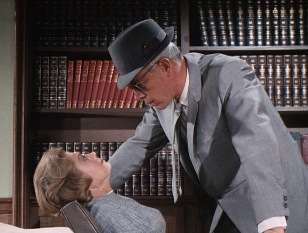
Clu performs a blindness aptitude test on a visually impaired woman.


Clu swabs his dirty sunglasses with sweat from Norman Fell's dampened head.


Clu takes a swig of Claude Akins' third-rate hooch, then, in a dick move, looks for a place on the floor to spit it out. (In real life Clu was a teetotaler.)

More on Clu in a bit.

#2. Lee Marvin. A.K.A. The Terrifying Intimate Verbal Sadism of Lee Marvin.

Lee really knows how to get in your personal space. Not many actors do. In the contemporary era, Rutger Hauer and Jimmy Smits come to mind, and perhaps a few others, but I think this is a filmmaking technique/acting skill which has sadly gone by the wayside. He's not your garden-variety sadist. Somehow, Lee Marvin taps into that primal element– that basic human relationship between child and adult– and translates it in a manner which cements his status as an adult in a world that is somehow now solely populated by mere children. Take heed: perhaps if you do as he says, he will not dismantle your body with his bare hands.

LEE MARVIN MIGHT LICK YOUR EAR

Which kind of leads us to–

#3. The Shit-Eating Grins of Lee Marvin.

He is one of the few purveyors of shit-eating grins that doesn't draw one's ire. Generally, a shit-eating grin elicits contempt from an audience. Lee's shit-eating grins elicit a certain degree of respect and a great deal of fright. And speaking of grins–

#4. The way that ex-NFL player Bob Phillips clenches his teeth whenever he's doing something violent.


Is it intentional? Your guess is as good as mine. "Oh, he's doing it as he commits crimes so that his victims will not recognize him," you say. Well, no- because in the first photograph, he's in private- in the company of thieves, if you will. But it doesn't really matter. Suffice it to say- I like it.

#5. The bored, perpetually droning racetrack announcer. He just goes on and on. I guess it's background chatter for the whole scene and was probably designed as the 'glue' which holds together disconnected shots of stock footage, but it's so dull, ambling, and emotionless that it becomes... comedy gold.

Yes, we've got some great cars out here today. Some great cars. Great cars.

#6. The most simplistic heist map in film history. 'We'll go over it again– and again!" snarls Reagan, but when we finally see the map, it's this beaut:

As a side note on the heist– it involves setting up a detour for an armored truck, hiding the detour after it takes the isolated country road, passing the truck on said road, and meeting up with a faked car wreck further on down which makes the armored truck stop so that it can be easily robbed. A key plot element involves racer Johnny North (John Cassavetes) recruited as the driver, because only he can drive fast enough to pass the truck on the bumpy path . But I ask– why does it have to pass the truck? Isn't the staged wreck on the secluded route enough? Nevermind– this is getting too complicated. Let's go over it again. May I refer you to the map above?

#7. Rear-projection Go-Kart Madness! This one kinda speaks for itself.


#8. The hilarious dynamic between Gulager and Marvin. Their colorless banter– "I always liked Miami." –"Yeah, it's a nice place." The fact that Gulager is a hand-gripper-squeezin', push-up doin', carrot-juice swiggin', milk-quaffin' health nut and that Marvin is a heavy boozin', darkly broodin', shirt starchin' hardass. They don't have a whole lot going on in their lives. Being a hit man's not exactly for enterprising, visionary-types. But you believe that Gulager enjoys his work and that Marvin is tired. And that's all you need to believe.


#9. Claude Akins, who proves himself yet again to be one hell of an actor, finishes his sob story. Real fuckin' tears stream down his grimy, disconsolate grease-monkey's face.


And the camera tracks out to reveal:

Gulager and Marvin: bored as shit.

#10. The fusion of artsy, 60's cinematography and a world of stock, prefabricated sets. It's an odd juxtaposition, and for the most part, the film looks like ubiquitous 60's American studio TV work. But every once in a while, DP Richard L. Rawlings (DYNASTY, CHARLIE'S ANGELS) pulls out something worthy of Antonioni. Did Siegel set up these shots himself?


#11. A bit, wordless role by John Cassavetes crony Seymour Cassel (possibly best known now for his work with Wes Anderson).


#12. During the 'ole steam room torture' scene, Clu concludes things by stating the classic, groan-inducing one-liner, "Then there's no sweat, Mickey."


#13. The way Lee Marvin says "YOU WAIT!" Just wait for it, and you'll see what I mean.

#14. Ronald Reagan Eyebrow Action. The man is throwing around more eyebrows than Nicholson and Slater combined. It's all he does. Each eyebrow toss is worth a thousand words. Every single one of them is gold.


These freeze frames likely represent about 5% of the actual eyebrow action that Reagan delivers. He even raises some brow carpet at Gulager, as he pretends to crash cars on Reagan's scale model of a real estate development.


He should've been a school principal.

#15. The big punch out scene which I referenced earlier. It's probably the most premeditated slap I've ever seen. Angie Dickinson is going on about how she'd prefer to stick around near Cassavetes. "I like it here," she says. Reagan arches an eyebrow, exchanges a look with his buddies and announces, "Well, I can change that in a hurry!" He stands, winds up, and delivers a slap so hearty that I hit 'instant replay' at least half a dozen times.


But it's not over– Cassavetes gets into the fray, stage-punching Reagan, who, in the few moments prior to getting ghost-hit contorts his face into something resembling a background character from L'IL ABNER or at the very least, DICK TRACY. They don't make 'em like they used to.


#16. Gulager and Marvin's gleeful torture of Angie Dickinson. Now this little item reflects, hopefully, more on the exquisite bitchiness of Dickinson's character and less on some deeply buried misogynism, but I defy you not to be having a blast while it's happening. "Don't bruise her, Charlie– she's got a lotta class."


#17. According to Clu Gulager, Lee Marvin was completely and utterly shitfaced when he filmed his final scenes. Of course, he still nailed his performance, and, if you believe Clu, which I always do, it's one of the greatest scenes in film history. And it never fails to evoke applause.

Amen.

-Sean Gill