


 Stars: 4 of 5.
Running Time: 93 minutes.
Notable Cast or Crew: Based on the short story by Stephen King. Starring Miguel Ferrer (TWIN PEAKS, ROBOCOP, TRAFFIC, son of José Ferrer, cousin of George Clooney), Julie Entwhistle (IN AND OUT), Dan Monahan (PORKY'S, PORKY'S II: THE NEXT DAY), Michael H. Moss (ROBOCOP 3, PASSENGER 57). Produced by Richard P. Rubenstein (DAWN OF THE DEAD, CREEPSHOW, TALES FROM THE DARKSIDE). Makeup and special effects by Greg Nicotero (ARMY OF DARKNESS, FROM DUSK TILL DAWN, THE WALKING DEAD, KILL BILL, DEADWOOD), Howard Berger (THE MIST, THE PEOPLE UNDER THE STAIRS, EVIL DEAD II, THE FACULTY, INGLORIOUS BASTERDS), and Robert Kurtzman (PREDATOR, HOUSE III, IN THE MOUTH OF MADNESS, SCREAM).
Tag-line: "Evil has a flight plan."
Best one-liner: "Never believe what you publish, and never publish what you believe."
While it does lay claim to a small cult following, THE NIGHT FLIER is nonetheless a relatively overlooked work when it comes to the Stephen King film canon. Is it a masterpiece? No. But it's a fun, gory thriller in the vein (no pun intended) of a long-form TALES FROM THE CRYPT or an X-FILES "Monster of the Week" episode that's held together with a strong, nuanced portrayal by snarky character actor extraordinaire, Miguel Ferrer.

Pictured: snarky character actor extraordinaire Miguel Ferrer.
Back in my review of THE DEAD ZONE, I wrote about the King character of "Richard Dees," a sleazoid reporter for a rag mag named "INSIDE VIEW," who makes appearances in THE DEAD ZONE novel and the short story "The Night Flier" (from the NIGHTMARES AND DREAMSCAPES collection). Dees is an absurd caricature of "the amoral newspaperman," combining the privacy-invasions of the paparazzi with the hilarious, outright dishonesty of THE NATIONAL ENQUIRER.

He's the sort of man who says "never print what you believe, and never believe what you print," the original yellow journalist. However, despite his outward lack of principles, you genuinely like him... sort of like every character Miguel Ferrer has ever brought to life!
Anyway, Ferrer's Dees is the protagonist of THE NIGHT FLIER, and he's seen here following a shadowy, cloaked figure who may or may not be a genuine vampire, an alleged blood-sucker who has adapted to modern times, jumping around from rural town to town overnight in a Cessna Skymaster, signing in as "Dwight Renfield" (alluding to Dwight Frye, the wonderful character actor who portrayed Renfield in the 1931 DRACULA), leaving behind unsolved murders, and always vanishing without a trace.

Part detective thriller, part morality tale, and part vampire horror, here's eight reasons why you ought to buckle up and take to the unfriendly skies with THE NIGHT FLIER, where evil has a flight plan, etc., etc....
#1. The exquisite dickery of Miguel Ferrer.


A lot of movies have characters who are callous, hardened individuals whose gruff exteriors mask hearts of gold. In the end, it is revealed that they always kept people at an arm's length because they really just needed some love and were afraid of rejection. Conversely, the deeper meaning here is that Miguel Ferrer's Rick Dees keeps people at an arm's length because he despises them.

He may be a chain-smoking, heavy-drinking misanthrope, but by God, he's our chain-smoking, heavy-drinking misanthrope!

Piloting his own Cessna, Ferrer's Dees chases the Night Flier across the country, kickin' back with his Ray-Bans, dictating to a tape recorder, and looking down with disdain at the ant-sized people below. Well done.
#2. Ferrer's boss, Dan Monahan (PORKY'S actor and fusion of Jeffrey Combs and Charles Martin Smith), insists that he's perfect for this particular job because he's "good with the hicks."


This of course recalls Ferrer's legendary role on TWIN PEAKS as FBI Agent Albert Rosenfield, a man who hated yokels with even more fervor than Richard Dees, and a man who frequently unleashed incredibly verbose bon mots such as the following:
#3. Poor man's Audrey Horne.
Continuing the TWIN PEAKS-ian chain of logic, I must note that the female lead here, Julie Entwhistle, is sort of a poor man's Audrey Horne, as depicted by these conveniently chosen screenshots.

Julie Entwhistle inside a closet.

Audrey Horne (Sherilyn Fenn) inside a closet.
The role she's playing (as an occasional victim and occasional foil) is not present in the original short story, but I get that they wanted to add some more female characters. Also of note is that Julie Entwhistle only ever appeared in one other film (as "Student" in IN AND OUT) which was also in 1997. Weird.
#4. Stephen King references galore.
This is truly for the SK nerds out there. At one point, Julie Entwhistle's character is looking at a wall of old, framed INSIDE VIEW covers. Each of them, only on screen for a few seconds, references a different Stephen King novel or short story:

"Satanic Shopkeeper Sells Gory Goodies" = NEEDFUL THINGS and "Naked Demons Leveled My Lawn" = THE LAWNMOWER MAN

"The Ultimate Killer Diet! Gypsy Curse Flayed at Lawyer's Flesh!" = THINNER
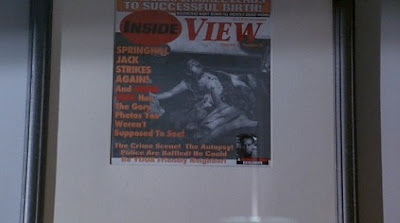
"Headless Lamaze Leads to Successful Birth" = THE BREATHING METHOD and "Springfield Jack Strikes Again" = STRAWBERRY SPRING
There's also "Kiddie Cultists in Kansas Worship Creepy Voodoo God!" in reference to CHILDREN OF THE CORN. Furthermore, at one point, Ferrer's character discusses a school teacher who murdered some demonic five-year-olds (a reference to the Bradbury-esque King short, "Suffer the Little Children"), and he visits an airfield in Derry, Maine (the home of IT and INSOMNIA).
Finally, he visits Wilmington, North Carolina, which has now become the filmic equivalent of Derry or Castle Rock, Maine for Stephen King adaptations ever since CAT'S EYE, FIRESTARTER, MAXIMUM OVERDRIVE, and SILVER BULLET were filmed there, thanks to Dino de Laurentiis' studio being located in Wilmington. So, whew. I hope that's enough Stephen King references for you.
#5. Expressionistic flourish.


There's a terrific black and white sequence that takes a little from NIGHT OF THE LIVING DEAD, and tonally prefigures THE MIST!
#6. Practical effects.

The legendary Berger, Kurtzman, and Nicotero are on the job (see some of their credits above), and they're having a helluva lotta fun. I'm obviously not going to show you the best stuff, or the monster himself– you'll have to see the movie for that. But let's take a moment to salute practical effects in THE NIGHT FLIER, which, in 1997, could have easily been replaced by terrible TV-worthy CGI.
#7. A vampire that orders a Bloody Mary.

As he hunts the vampire, Ferrer receives several warnings to cease and desist his investigation. My favorite comes in a local bar when a shadowy man orders him a drink and disappears. The drink, obviously, is a Bloody Mary and the napkin has a message in red marker: "STOP NOW." A: I love that the vampire actually ordered a Bloody Mary, because, of course. B: I love that the vampire was considerate enough to buy Ferrer a drink. I mean, he could've just dropped the napkin on his lap or something.
#8. The reveal of the vampire. (I'm going to remain relatively spoiler-free here, and I'm definitely not going to spoil what the vampire looks like, despite the fact that it's an amazingly well-done makeup effect and has already been plastered all over the DVD case and the disc art and the menu screens and most of the posters.)
The first part is copied, nearly verbatim, from the short story– a wonderfully suspenseful scene where our hero sees a stream of blood flowing from an invisible source into a urinal, reflected in a bathroom mirror.


The inability to turn around and see the actual creature builds a kind of dreamlike tension that reaches a minor state of perfection. [ Also, this begs the question, is the vampire from the "popped-collar zone?" (See #3 in my DEAD ZONE review.)]
Anyway, the film nails the final moments of the short story, and then continues for a few minutes more, straight into TALES OF THE CRYPT/TWILIGHT ZONE-style coda. Though I thought the short story ended perfectly, I don't really mind the extension here– I mean, this is a story about a Cessna-piloting vampire– the filmmakers should be able to take a few liberties now and again.

YAHHHHHHH
Four stars.
–Sean Gill
While it does lay claim to a small cult following, THE NIGHT FLIER is nonetheless a relatively overlooked work when it comes to the Stephen King film canon. Is it a masterpiece? No. But it's a fun, gory thriller in the vein (no pun intended) of a long-form TALES FROM THE CRYPT or an X-FILES "Monster of the Week" episode that's held together with a strong, nuanced portrayal by snarky character actor extraordinaire, Miguel Ferrer.

Pictured: snarky character actor extraordinaire Miguel Ferrer.
Back in my review of THE DEAD ZONE, I wrote about the King character of "Richard Dees," a sleazoid reporter for a rag mag named "INSIDE VIEW," who makes appearances in THE DEAD ZONE novel and the short story "The Night Flier" (from the NIGHTMARES AND DREAMSCAPES collection). Dees is an absurd caricature of "the amoral newspaperman," combining the privacy-invasions of the paparazzi with the hilarious, outright dishonesty of THE NATIONAL ENQUIRER.

He's the sort of man who says "never print what you believe, and never believe what you print," the original yellow journalist. However, despite his outward lack of principles, you genuinely like him... sort of like every character Miguel Ferrer has ever brought to life!
Anyway, Ferrer's Dees is the protagonist of THE NIGHT FLIER, and he's seen here following a shadowy, cloaked figure who may or may not be a genuine vampire, an alleged blood-sucker who has adapted to modern times, jumping around from rural town to town overnight in a Cessna Skymaster, signing in as "Dwight Renfield" (alluding to Dwight Frye, the wonderful character actor who portrayed Renfield in the 1931 DRACULA), leaving behind unsolved murders, and always vanishing without a trace.

Part detective thriller, part morality tale, and part vampire horror, here's eight reasons why you ought to buckle up and take to the unfriendly skies with THE NIGHT FLIER, where evil has a flight plan, etc., etc....
#1. The exquisite dickery of Miguel Ferrer.


A lot of movies have characters who are callous, hardened individuals whose gruff exteriors mask hearts of gold. In the end, it is revealed that they always kept people at an arm's length because they really just needed some love and were afraid of rejection. Conversely, the deeper meaning here is that Miguel Ferrer's Rick Dees keeps people at an arm's length because he despises them.

He may be a chain-smoking, heavy-drinking misanthrope, but by God, he's our chain-smoking, heavy-drinking misanthrope!

Piloting his own Cessna, Ferrer's Dees chases the Night Flier across the country, kickin' back with his Ray-Bans, dictating to a tape recorder, and looking down with disdain at the ant-sized people below. Well done.
#2. Ferrer's boss, Dan Monahan (PORKY'S actor and fusion of Jeffrey Combs and Charles Martin Smith), insists that he's perfect for this particular job because he's "good with the hicks."


This of course recalls Ferrer's legendary role on TWIN PEAKS as FBI Agent Albert Rosenfield, a man who hated yokels with even more fervor than Richard Dees, and a man who frequently unleashed incredibly verbose bon mots such as the following:
"Mr. Horne, I realize that your position in this fair community pretty well guarantees venality, insincerity, and a rather irritating method of expressing yourself. Stupidity, however, is not necessarily a inherent trait, therefore, please listen closely. You can have a funeral any old time. You dig a hole, you plant a coffin. I, however, cannot perform these tests next year, next month, next week or tomorrow - I must perform them now. I've got a lot of cutting and pasting to do, gentlemen, so why don't you please return to your porch rockers and resume whittling. "It's too bad that all that TWIN PEAKS season 3 talk ended up being hogwash, because I dearly would have loved to see Miguel Ferrer come back as Albert Rosenfield and do his snobbish thing. Anyway, let's get back on topic–
#3. Poor man's Audrey Horne.
Continuing the TWIN PEAKS-ian chain of logic, I must note that the female lead here, Julie Entwhistle, is sort of a poor man's Audrey Horne, as depicted by these conveniently chosen screenshots.

Julie Entwhistle inside a closet.

Audrey Horne (Sherilyn Fenn) inside a closet.
The role she's playing (as an occasional victim and occasional foil) is not present in the original short story, but I get that they wanted to add some more female characters. Also of note is that Julie Entwhistle only ever appeared in one other film (as "Student" in IN AND OUT) which was also in 1997. Weird.
#4. Stephen King references galore.
This is truly for the SK nerds out there. At one point, Julie Entwhistle's character is looking at a wall of old, framed INSIDE VIEW covers. Each of them, only on screen for a few seconds, references a different Stephen King novel or short story:
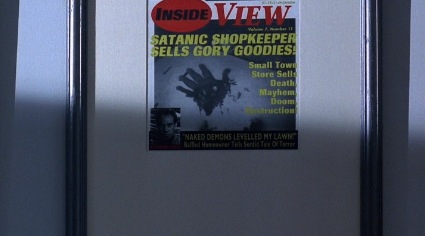
"Satanic Shopkeeper Sells Gory Goodies" = NEEDFUL THINGS and "Naked Demons Leveled My Lawn" = THE LAWNMOWER MAN

"The Ultimate Killer Diet! Gypsy Curse Flayed at Lawyer's Flesh!" = THINNER

"Headless Lamaze Leads to Successful Birth" = THE BREATHING METHOD and "Springfield Jack Strikes Again" = STRAWBERRY SPRING
There's also "Kiddie Cultists in Kansas Worship Creepy Voodoo God!" in reference to CHILDREN OF THE CORN. Furthermore, at one point, Ferrer's character discusses a school teacher who murdered some demonic five-year-olds (a reference to the Bradbury-esque King short, "Suffer the Little Children"), and he visits an airfield in Derry, Maine (the home of IT and INSOMNIA).
Finally, he visits Wilmington, North Carolina, which has now become the filmic equivalent of Derry or Castle Rock, Maine for Stephen King adaptations ever since CAT'S EYE, FIRESTARTER, MAXIMUM OVERDRIVE, and SILVER BULLET were filmed there, thanks to Dino de Laurentiis' studio being located in Wilmington. So, whew. I hope that's enough Stephen King references for you.
#5. Expressionistic flourish.


There's a terrific black and white sequence that takes a little from NIGHT OF THE LIVING DEAD, and tonally prefigures THE MIST!
#6. Practical effects.

The legendary Berger, Kurtzman, and Nicotero are on the job (see some of their credits above), and they're having a helluva lotta fun. I'm obviously not going to show you the best stuff, or the monster himself– you'll have to see the movie for that. But let's take a moment to salute practical effects in THE NIGHT FLIER, which, in 1997, could have easily been replaced by terrible TV-worthy CGI.
#7. A vampire that orders a Bloody Mary.
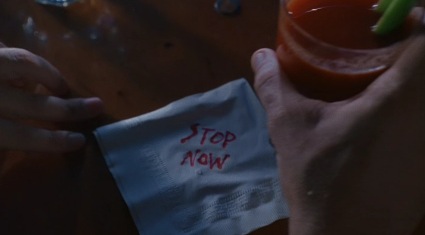
As he hunts the vampire, Ferrer receives several warnings to cease and desist his investigation. My favorite comes in a local bar when a shadowy man orders him a drink and disappears. The drink, obviously, is a Bloody Mary and the napkin has a message in red marker: "STOP NOW." A: I love that the vampire actually ordered a Bloody Mary, because, of course. B: I love that the vampire was considerate enough to buy Ferrer a drink. I mean, he could've just dropped the napkin on his lap or something.
#8. The reveal of the vampire. (I'm going to remain relatively spoiler-free here, and I'm definitely not going to spoil what the vampire looks like, despite the fact that it's an amazingly well-done makeup effect and has already been plastered all over the DVD case and the disc art and the menu screens and most of the posters.)
The first part is copied, nearly verbatim, from the short story– a wonderfully suspenseful scene where our hero sees a stream of blood flowing from an invisible source into a urinal, reflected in a bathroom mirror.


The inability to turn around and see the actual creature builds a kind of dreamlike tension that reaches a minor state of perfection. [ Also, this begs the question, is the vampire from the "popped-collar zone?" (See #3 in my DEAD ZONE review.)]
Anyway, the film nails the final moments of the short story, and then continues for a few minutes more, straight into TALES OF THE CRYPT/TWILIGHT ZONE-style coda. Though I thought the short story ended perfectly, I don't really mind the extension here– I mean, this is a story about a Cessna-piloting vampire– the filmmakers should be able to take a few liberties now and again.

YAHHHHHHH
Four stars.
–Sean Gill


