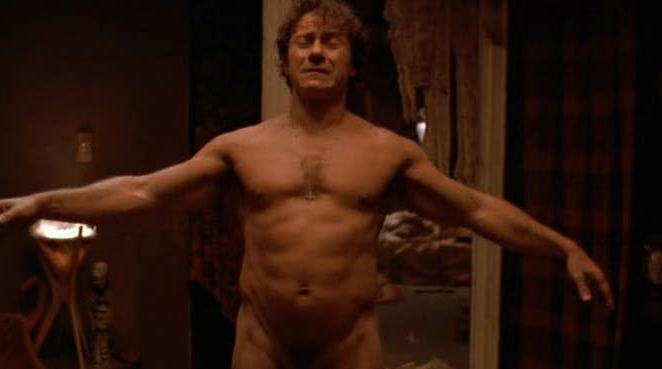
60. VIDEODROME (1983, David Cronenberg)

In IN THE MOUTH OF MADNESS, John Carpenter nailed the H.P. Lovecraft atmosphere, possibly because he didn't attempt a direct adaptation– he was free to take what the "Lovecraft vibe" meant to him, and apply it in his own way, on his own terms. David Cronenberg does the same thing here, but with Philip K. Dick, and it's goddamned fantastic. James Woods is doin' that skeezy thing that he does, searching for cheap n' vicious cable TV thrills and engaging in a talk show-mance with Debbie Harry, who's pretty busy burning herself with cigarettes and giving herself unsanitary, impromptu body piercings. Meanwhile, cerebral cortexes are becoming infected and tainted with throbbing tele-tumors; abdomens are sprouting unexpected, vaginal VHS players; hands and guns are reshaping themselves, resculpting flesh and blood and steel; and Howard Shore's soundtrack is thrumming along in the background, threatening to drag us back into the pit, or possibly inviting us to evolve. Thankfully, it's got a (mean) streak of pitch-black hilarity, too– for otherwise we might go insane with sheer dread!– it ranges from visual puns to S&M wackiness to spit-take inducing gore to James Woods turning that Sleaze-O-Meter up to eleven and beyond. The first time I saw this was at college, alone, after hours, on a VHS player, deep in the bowels of the Audio Visual Department. Afterward, I half-expected the television to explode into a confetti of viscera; expected the tape itself to begin pulsating wetly in my hands. A powerful film; and, along with Rob Bottin's work on THE THING, Rick Baker's practical special and makeup effects here may very well be the pinnacle of "movie magic," period.
59. ALL THAT JAZZ (1979, Bob Fosse)

Bob Fosse's ALL THAT JAZZ is equal parts auto-biopic, Hollywood musical, and self-chastisement, at once both a swansong and a death rattle. Fosse didn't pass away until 1987, but eight years prior, with ALL THAT JAZZ, he submits, for our consideration, his greatest passions, achievements, nostalgias and lamentations. Roy Scheider, as Fosse's stand-in, warrants every superlative from tour-de-force to powerhouse, his performance as multi-faceted, in-the-moment, and self-reflective as Fosse's unique vision demands. The use of quotidian repetition (visually and aurally indicated in this film by contact lenses, Dexedrine, showering, and Vivaldi's "Concerto Alla Rustica") has never been more effective. Darren Aronofsky's similar stagings in PI and REQUIEM FOR A DREAM feel particularly empty . In Fosse's world, the wreckage of one's life piles on top of itself endlessly- the womanizing, the drug use, regret over familial relationships- and it can all be wiped clean by the promise of a new day ("It's showtime, folks!), everything a rehearsal for a rehearsal, a neverending series of highs and lows which one isn't forced to consider until the end of the line. Thus, Fosse sits in a cobbled-together dressing room limbo netherworld, confronted by Angelique (Jessica Lange), his interviewer, companion, and confessor, contemplating his demise and the life that led up to it. And it's all concurrent: his deathbed, his rehearsals, his family life, childhood embarrassments, in the editing room for LENNY- the comedic monologue on death alternating meanings with each iteration, budget meetings, business brunches, the final act of the last show of one's life and the ultimate send-off with one foot in the grave and one foot on the stage.
An unrivaled rumination on the life of a man who was as susceptible to flattery as he was to self-loathing, who was as much a scoundrel as he was an artist. Five stars.
58. METROPOLITAN (1990, Whit Stillman)

"Is our language so impoverished that we have to use acronyms of French phrases to make ourselves understood?" "-Yes." Like some fragile, carefully festooned porcelain ornament long misplaced, METROPOLITAN emerged in 1990, not with a roar, but rather with an eloquent whisper and an arched eyebrow. Whit Stillman's talent, initially misdiagnosed as Woody Allen-esque, was truly, autobiographically, anachronistically (think F. Scott Fitzgerald unstuck in time with a light dose of John Hughes) original, and it paved the way for such wordy American indie auteurs as Noah Baumbach and Wes Anderson. METROPOLITAN also heralded the arrival of one of the great underappreciated actors of our time, Christopher Eigeman (BARCELONA, KICKING AND SCREAMING). The craftsmanship and hilarity of this script cannot be exaggerated. Endlessly quotable, I find myself held rapt by the exquisite dialogue as one might marvel over a ship-in-a-bottle. Needless to say, it's not for everyone, and if a line like "Girls that have been degraded by you don't need the further humiliation of having their names bandied about non-exclusive Park Avenue after-parties!" doesn't appeal to you, then you probably shouldn't be watching this. The plot is simple, and it unfolds with subtlety and grace: one Christmas vacation, not so long ago, proletarian Fourierist Tom (Edward Clements) is immersed by chance in Manhattan's upper-crust deb world. Gentle, nuanced comedy ensues as he meets the snarky Nick (Eigeman), the tragically naive Charlie (Taylor Nichols), the titled aristocratic tool Von Sloneker (Will Kempe), the melancholy Molly Ringwald-type Audrey (Carolyn Farina), and many others. The film finds true, wry emotive power, however, in its last act, which finds Tom and Charlie cast adrift without their 'id,' Nick, and caught amid a sea of varying premature ideas of failure. An excellent film, and a true silver-tongued jewel in the crown of American independent cinema.
57. BARFLY (1987, Barbet Schroeder)

"And as my hands drop the last desperate pen, in some cheap room, they will find me there and never know my name, my meaning, nor the treasure of my escape." BARFLY is not a pitiful, kitchen sink drama about down-on-their-luck losers. It's not sappy award-season fodder, manipulatively constructed for tugging upon heartstrings and emptying tear-wells. And it's not some slacker ode, designed as a pat on the back for white-bred goof-offs who occasionally daydream about what it'd be like to take a week off work to go on a bender. BARFLY is sincerely dangerous and dangerously sincere, and it is because BARFLY is a philosophy. BARFLY is about winnin' one for the bums, even if that means yankin' the pillars of civilization down on all our heads. It's about taking one's intellect- a genius that could surely have moved mountains– and applying it instead to more expedient techniques for fucking with the night bartender at the local saloon (played with knuckleheaded élan by Frank Stallone).
Its dipsomaniacal protagonist, Henry Chinaski (a recurring Bukowski alter-ego– well, let's just be honest and say 'a Bukowski with a different name'), is played by Mickey Rourke with lunatic gusto which ever threatens to escape the mere confines of the cinema-frame. He lurches about like a movie-monster, dragging his feet like Frankenstein, teetering on his haunches like the Hunchback of Notre Dame, leering like Dwight Frye. He is a gutter-poet, an amateur street-fighter, and a professional drunk. His entire life is a war waged against the status quo, the skirmishes and campaigns of which take place in stagnant, lonely flophouses; noxious, grotty gin-joints; and desolate street corners at 3:00 in the morning. His many victories against society are private ones- they are not sung from the rooftops or celebrated annually by giggling schoolchildren– they're for himself, and for himself only. A wry, split-lip smile reflected back by cracked, dirty mirror.
I did a lengthy write-up on this flick (and the accompanying Q&A) last fall, and after nearly a year of reflection, I must say that BARFLY is King of the Cannon Canon– one of those rare adaptations of a writer's body of work which really captures the spirit of the artist, and in Bukowski's case, it's like white-hot lightning in a 40 oz. bottle.
56. BIGGER THAN LIFE (1956, Nicholas Ray)

"Childhood is a congenital disease - and the purpose of education is to cure it. We're breeding a race of moral midgets." Ostensibly a tale about addiction to prescription drugs, BIGGER THAN LIFE is really about an addiction to values; even going so far as to prove the collective insanity which is our society's bedrock, simply by upholding its more respected tenets... TO THE DEATH! James Mason takes the moral code of the LEAVE IT TO BEAVER-generation and amplifies it, distorts it, makes it 'bigger than life,' makes it a grotesque. His performance is terrifying and absolutely inspired, it's one of the most impressive acting achievements of the 50s. All of this is draped across an expressionistic CinemaScope frame, bursting with bold shadows and Technicolor insanity courtesy of ex-noir standby Joe MacDonald (PICKUP ON SOUTH STREET, PANIC IN THE STREETS, CALL NORTHSIDE 777). I don't wish to give too much more away along with my whole-hearted recommendation, but it's certainly one of the bleakest, blackest films of the 50s, and, if I'm not mistaken, is surely the inspiration for All-American dad Leland Palmer in David Lynch's TWIN PEAKS. (Also, a whirlwind shopping trip whereupon James Mason forces his wife to try on fancy frock after frock after frock ad nauseum is well worth the price of admission alone.) It's astounding that this was even allowed to be made. You'll laugh, you'll cry, you'll cower in fear. What more do you want?
Coming up next... Clint Eastwood times two, the rockin' tunes of Goblin, and some Frenchie neo-noir!
Previously on the countdown:
#65-61
#70-66
#75-71
#80-76
#85-81
#90-86
#95-91
#100-96
Runners-up Part 1
Runners-up Part 2

In IN THE MOUTH OF MADNESS, John Carpenter nailed the H.P. Lovecraft atmosphere, possibly because he didn't attempt a direct adaptation– he was free to take what the "Lovecraft vibe" meant to him, and apply it in his own way, on his own terms. David Cronenberg does the same thing here, but with Philip K. Dick, and it's goddamned fantastic. James Woods is doin' that skeezy thing that he does, searching for cheap n' vicious cable TV thrills and engaging in a talk show-mance with Debbie Harry, who's pretty busy burning herself with cigarettes and giving herself unsanitary, impromptu body piercings. Meanwhile, cerebral cortexes are becoming infected and tainted with throbbing tele-tumors; abdomens are sprouting unexpected, vaginal VHS players; hands and guns are reshaping themselves, resculpting flesh and blood and steel; and Howard Shore's soundtrack is thrumming along in the background, threatening to drag us back into the pit, or possibly inviting us to evolve. Thankfully, it's got a (mean) streak of pitch-black hilarity, too– for otherwise we might go insane with sheer dread!– it ranges from visual puns to S&M wackiness to spit-take inducing gore to James Woods turning that Sleaze-O-Meter up to eleven and beyond. The first time I saw this was at college, alone, after hours, on a VHS player, deep in the bowels of the Audio Visual Department. Afterward, I half-expected the television to explode into a confetti of viscera; expected the tape itself to begin pulsating wetly in my hands. A powerful film; and, along with Rob Bottin's work on THE THING, Rick Baker's practical special and makeup effects here may very well be the pinnacle of "movie magic," period.
59. ALL THAT JAZZ (1979, Bob Fosse)

Bob Fosse's ALL THAT JAZZ is equal parts auto-biopic, Hollywood musical, and self-chastisement, at once both a swansong and a death rattle. Fosse didn't pass away until 1987, but eight years prior, with ALL THAT JAZZ, he submits, for our consideration, his greatest passions, achievements, nostalgias and lamentations. Roy Scheider, as Fosse's stand-in, warrants every superlative from tour-de-force to powerhouse, his performance as multi-faceted, in-the-moment, and self-reflective as Fosse's unique vision demands. The use of quotidian repetition (visually and aurally indicated in this film by contact lenses, Dexedrine, showering, and Vivaldi's "Concerto Alla Rustica") has never been more effective. Darren Aronofsky's similar stagings in PI and REQUIEM FOR A DREAM feel particularly empty . In Fosse's world, the wreckage of one's life piles on top of itself endlessly- the womanizing, the drug use, regret over familial relationships- and it can all be wiped clean by the promise of a new day ("It's showtime, folks!), everything a rehearsal for a rehearsal, a neverending series of highs and lows which one isn't forced to consider until the end of the line. Thus, Fosse sits in a cobbled-together dressing room limbo netherworld, confronted by Angelique (Jessica Lange), his interviewer, companion, and confessor, contemplating his demise and the life that led up to it. And it's all concurrent: his deathbed, his rehearsals, his family life, childhood embarrassments, in the editing room for LENNY- the comedic monologue on death alternating meanings with each iteration, budget meetings, business brunches, the final act of the last show of one's life and the ultimate send-off with one foot in the grave and one foot on the stage.
An unrivaled rumination on the life of a man who was as susceptible to flattery as he was to self-loathing, who was as much a scoundrel as he was an artist. Five stars.
58. METROPOLITAN (1990, Whit Stillman)

"Is our language so impoverished that we have to use acronyms of French phrases to make ourselves understood?" "-Yes." Like some fragile, carefully festooned porcelain ornament long misplaced, METROPOLITAN emerged in 1990, not with a roar, but rather with an eloquent whisper and an arched eyebrow. Whit Stillman's talent, initially misdiagnosed as Woody Allen-esque, was truly, autobiographically, anachronistically (think F. Scott Fitzgerald unstuck in time with a light dose of John Hughes) original, and it paved the way for such wordy American indie auteurs as Noah Baumbach and Wes Anderson. METROPOLITAN also heralded the arrival of one of the great underappreciated actors of our time, Christopher Eigeman (BARCELONA, KICKING AND SCREAMING). The craftsmanship and hilarity of this script cannot be exaggerated. Endlessly quotable, I find myself held rapt by the exquisite dialogue as one might marvel over a ship-in-a-bottle. Needless to say, it's not for everyone, and if a line like "Girls that have been degraded by you don't need the further humiliation of having their names bandied about non-exclusive Park Avenue after-parties!" doesn't appeal to you, then you probably shouldn't be watching this. The plot is simple, and it unfolds with subtlety and grace: one Christmas vacation, not so long ago, proletarian Fourierist Tom (Edward Clements) is immersed by chance in Manhattan's upper-crust deb world. Gentle, nuanced comedy ensues as he meets the snarky Nick (Eigeman), the tragically naive Charlie (Taylor Nichols), the titled aristocratic tool Von Sloneker (Will Kempe), the melancholy Molly Ringwald-type Audrey (Carolyn Farina), and many others. The film finds true, wry emotive power, however, in its last act, which finds Tom and Charlie cast adrift without their 'id,' Nick, and caught amid a sea of varying premature ideas of failure. An excellent film, and a true silver-tongued jewel in the crown of American independent cinema.
57. BARFLY (1987, Barbet Schroeder)

"And as my hands drop the last desperate pen, in some cheap room, they will find me there and never know my name, my meaning, nor the treasure of my escape." BARFLY is not a pitiful, kitchen sink drama about down-on-their-luck losers. It's not sappy award-season fodder, manipulatively constructed for tugging upon heartstrings and emptying tear-wells. And it's not some slacker ode, designed as a pat on the back for white-bred goof-offs who occasionally daydream about what it'd be like to take a week off work to go on a bender. BARFLY is sincerely dangerous and dangerously sincere, and it is because BARFLY is a philosophy. BARFLY is about winnin' one for the bums, even if that means yankin' the pillars of civilization down on all our heads. It's about taking one's intellect- a genius that could surely have moved mountains– and applying it instead to more expedient techniques for fucking with the night bartender at the local saloon (played with knuckleheaded élan by Frank Stallone).
Its dipsomaniacal protagonist, Henry Chinaski (a recurring Bukowski alter-ego– well, let's just be honest and say 'a Bukowski with a different name'), is played by Mickey Rourke with lunatic gusto which ever threatens to escape the mere confines of the cinema-frame. He lurches about like a movie-monster, dragging his feet like Frankenstein, teetering on his haunches like the Hunchback of Notre Dame, leering like Dwight Frye. He is a gutter-poet, an amateur street-fighter, and a professional drunk. His entire life is a war waged against the status quo, the skirmishes and campaigns of which take place in stagnant, lonely flophouses; noxious, grotty gin-joints; and desolate street corners at 3:00 in the morning. His many victories against society are private ones- they are not sung from the rooftops or celebrated annually by giggling schoolchildren– they're for himself, and for himself only. A wry, split-lip smile reflected back by cracked, dirty mirror.
I did a lengthy write-up on this flick (and the accompanying Q&A) last fall, and after nearly a year of reflection, I must say that BARFLY is King of the Cannon Canon– one of those rare adaptations of a writer's body of work which really captures the spirit of the artist, and in Bukowski's case, it's like white-hot lightning in a 40 oz. bottle.
56. BIGGER THAN LIFE (1956, Nicholas Ray)

"Childhood is a congenital disease - and the purpose of education is to cure it. We're breeding a race of moral midgets." Ostensibly a tale about addiction to prescription drugs, BIGGER THAN LIFE is really about an addiction to values; even going so far as to prove the collective insanity which is our society's bedrock, simply by upholding its more respected tenets... TO THE DEATH! James Mason takes the moral code of the LEAVE IT TO BEAVER-generation and amplifies it, distorts it, makes it 'bigger than life,' makes it a grotesque. His performance is terrifying and absolutely inspired, it's one of the most impressive acting achievements of the 50s. All of this is draped across an expressionistic CinemaScope frame, bursting with bold shadows and Technicolor insanity courtesy of ex-noir standby Joe MacDonald (PICKUP ON SOUTH STREET, PANIC IN THE STREETS, CALL NORTHSIDE 777). I don't wish to give too much more away along with my whole-hearted recommendation, but it's certainly one of the bleakest, blackest films of the 50s, and, if I'm not mistaken, is surely the inspiration for All-American dad Leland Palmer in David Lynch's TWIN PEAKS. (Also, a whirlwind shopping trip whereupon James Mason forces his wife to try on fancy frock after frock after frock ad nauseum is well worth the price of admission alone.) It's astounding that this was even allowed to be made. You'll laugh, you'll cry, you'll cower in fear. What more do you want?
Coming up next... Clint Eastwood times two, the rockin' tunes of Goblin, and some Frenchie neo-noir!
Previously on the countdown:
#65-61
#70-66
#75-71
#80-76
#85-81
#90-86
#95-91
#100-96
Runners-up Part 1
Runners-up Part 2